Why Olive Oil Pourer Closures Matter
Olive oil packaging has to do more than look attractive on a shelf. It must protect the product, support clean dispensing, travel safely through distribution, and feel reliable after the customer opens the bottle. A premium glass bottle can lose value quickly if the closure leaks, drips down the neck, or makes the product difficult to pour.
That is why olive oil pourer closures are such an important part of the packaging system. They control the oil stream, reduce mess, support tamper evidence, and improve the customer’s daily experience. For gourmet olive oil brands, private-label producers, foodservice suppliers, and export-focused bottlers, the closure is both a functional component and a visible part of the brand.
Kandacork Closures develops olive oil closure systems for brands that need a cleaner pour, better fitment, and stronger shelf presentation. Whether the project requires anti-drip olive oil caps, T-cap pourers, ROPP caps with inserts, or non-refillable systems, the right solution should match the bottle neck, oil viscosity, filling method, sales channel, and branding goal.
Key Takeaways for Buyers
Olive oil pourer closures help bottles pour cleanly, reduce dripping, reseal securely, and support product integrity after opening.
The right closure depends on bottle neck finish, pour speed, application method, food-contact material requirements, and brand positioning.
Premium olive oil brands often benefit from custom caps because the closure affects both consumer experience and shelf appeal.
ROPP caps, T-cap pourers, DOP closures, integrated screw caps, and non-refillable systems each serve different packaging and distribution needs.
Before ordering bulk olive oil pourer caps, buyers should confirm bottle drawings, neck finish, oil viscosity, filling process, capping method, target market, and decoration requirements.
What Are Olive Oil Pourer Closures?
Olive oil pourer closures are caps, inserts, or stopper-style systems that seal olive oil bottles while controlling how the oil flows after opening. They are commonly used for premium olive oil, private-label oils, gourmet condiments, vinegar, infused oils, and hospitality packaging.
Unlike a basic cap, an olive oil pourer closure usually includes a controlled-flow insert, spout, plug, liner, valve, shank, or tamper-evident structure. These components help manage the stream of oil as the bottle is tilted. A well-designed pourer also supports air return, which helps reduce glugging and uneven dispensing.
A complete closure system may include an outer cap, pourer insert, sealing liner, tamper-evident band, non-refillable valve, decorative top, and bottle-neck fitment section. The best design depends on the bottle format, neck finish, oil viscosity, target market, and production process.
For brands comparing olive oil pourer and closure solutions, the key question is not only “Does it fit?” but “Does it pour cleanly, seal reliably, look right, and run well in production?”
Why Olive Oil Brands Use Pourer Closures Instead of Basic Caps
Basic caps are suitable when the only goal is sealing. Olive oil, however, is often used slowly over time. Customers expect the bottle to pour cleanly, close securely, and remain attractive on a kitchen counter, restaurant table, or retail shelf.
Olive oil pourer closures improve pouring control. A controlled-pour insert helps the user drizzle, dose, or pour with more consistency. This matters for salad dressing, bread dipping, cooking, finishing dishes, tasting rooms, and tabletop service.
They also reduce waste and mess. Anti-drip olive oil caps can help keep the bottle neck, label, and table surface cleaner. For premium products, this small functional detail has a direct effect on perceived quality.
Tamper-evident closures and non-refillable systems also support product integrity. In retail, export, hospitality, and restaurant environments, buyers may want visible evidence that the bottle has not been opened or refilled.
For branding, the closure is part of the visual package. A custom olive oil pourer closure can use a wood top, aluminum finish, matte color, metallic surface, embossed logo, or color-matched design. These details help connect the cap with the bottle, label, carton, and price positioning.
Do Olive Oil Pourer Closures Help Protect Freshness?
Olive oil pourer closures can help protect freshness by reducing unnecessary exposure after opening, but the closure is only one part of the protection system. Olive oil quality is also affected by oxygen exposure, light, heat, bottle color, headspace control, filling quality, and storage conditions.
A closure with a reliable seal helps limit open exposure between uses. A dust cover, self-closing pourer, or resealable cap can also improve hygiene and reduce the chance of kitchen contaminants entering the bottle.
For extra virgin olive oil, packaging should work as a complete system. Dark glass, clean filling, reliable sealing, proper storage, and a suitable pourer closure all contribute to a better consumer experience. The International Olive Council standards and methods provide an important reference point for olive oil quality classification and sector terminology.
Main Types of Olive Oil Pourer Closures
Integrated Pourer Screw Caps
Integrated pourer screw caps combine a threaded cap with a built-in pouring insert. They are widely used for olive oil and vinegar bottles because they are practical, cost-efficient, and suitable for many retail packaging formats.
These caps are often selected for standard glass bottles in 250 ml, 500 ml, 750 ml, and 1 L formats. Many buyers search for 31.5 mm olive oil caps, but cap diameter alone is not enough. Thread profile, neck height, inner bore, sealing surface, and bottle tolerance all affect closure performance.
Integrated pourer screw caps are suitable for brands that need reliable everyday pouring without moving into a more premium stopper-style closure.
ROPP Caps with Pourer Inserts
ROPP means roll-on pilfer-proof. A ROPP cap is usually applied by machine, where an aluminum shell is rolled onto the bottle neck to form the thread and tamper-evident band. For olive oil bottles, ROPP caps can be paired with pourer inserts to combine clean dispensing with visible tamper evidence.
ROPP caps are a strong option for commercial bottling lines, export packaging, supermarket retail, and private-label programs. They support consistent application, efficient production, and a secure retail presentation.
When buyers compare ROPP closure options, the main technical considerations include bottle finish compatibility, cap shell dimensions, liner selection, insert fit, capping head setup, opening torque, and band break performance.
T-Cap Olive Oil Pourers
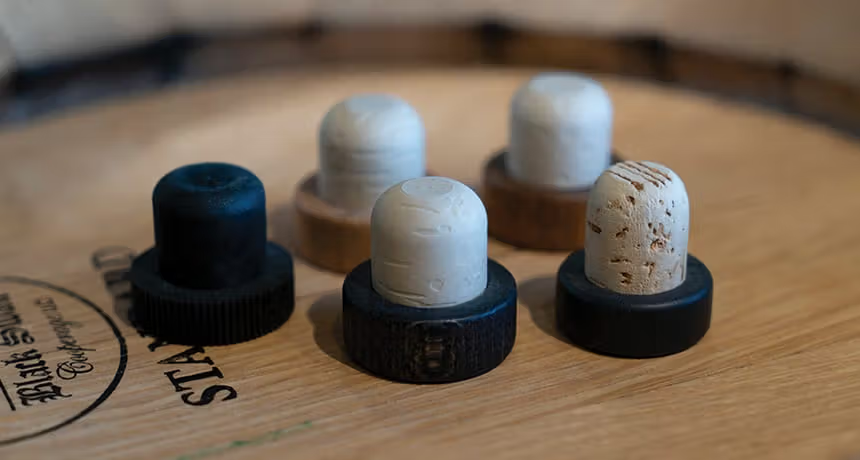
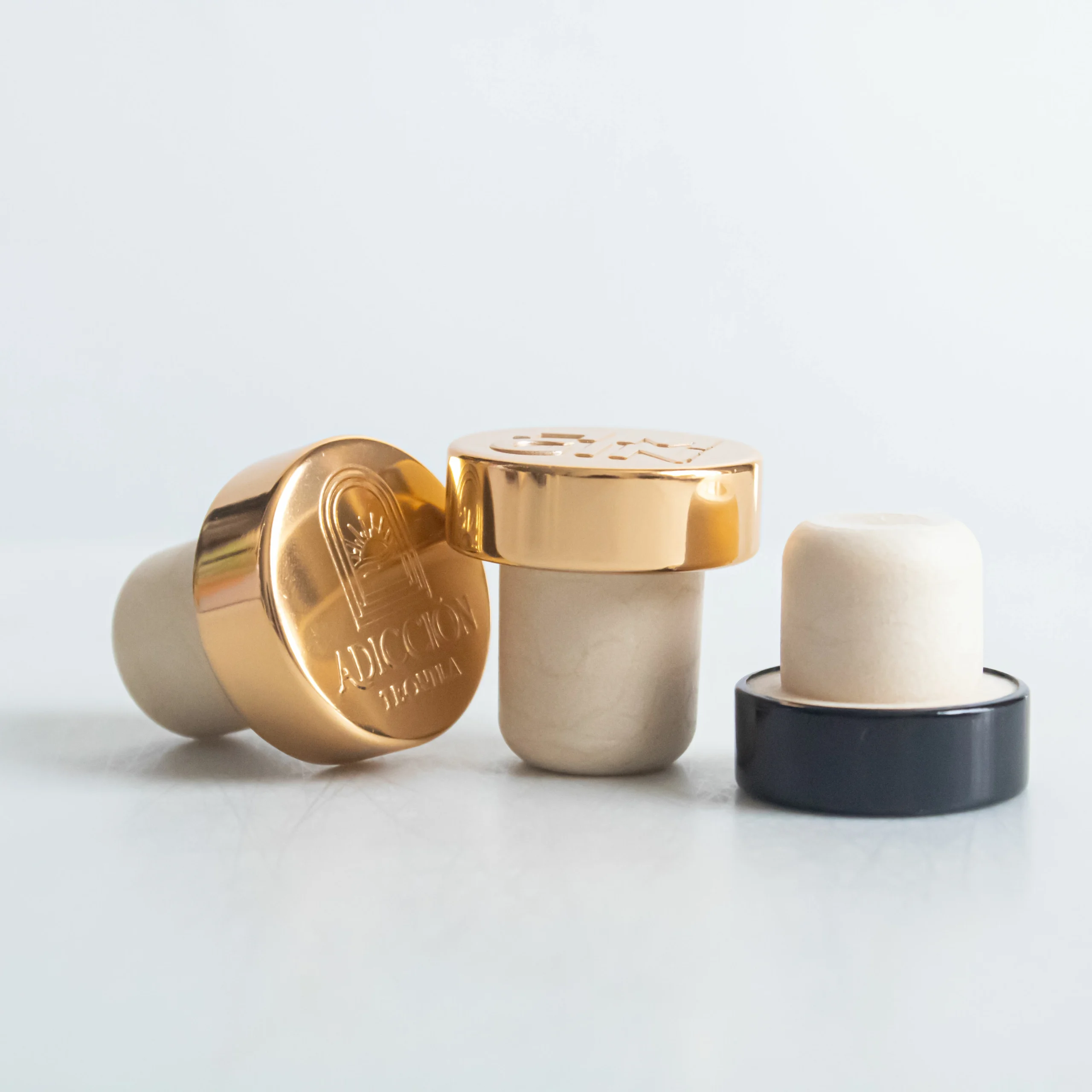
T-cap olive oil pourers are often chosen for premium, gourmet, gift, and hospitality packaging. A T-cap usually has a decorative top and a shank that fits into the bottle neck. For olive oil, the shank or insert can be designed to support smoother pouring and cleaner cutoff.
The top can be made from wood, aluminum, plastic, synthetic materials, or composite materials. This gives brands more design flexibility than standard commodity caps. A natural wood top may suit an artisanal estate olive oil, while a matte black or brushed aluminum top may suit a modern premium label.
T-cap olive oil pourer closures are ideal when the closure needs to communicate quality before the customer opens the bottle. They are especially useful for gift sets, tasting collections, boutique food packaging, and premium retail shelves.
DOP and Non-Refillable Pouring Closures
DOP and non-refillable olive oil closures are designed to reduce the risk of unauthorized refilling. These closures are useful in hospitality, restaurant service, controlled distribution, and export markets where brand protection matters.
A non-refillable pouring closure can help protect the brand from refill misuse after the original product is consumed. This is important for premium olive oil brands that want to maintain trust in restaurants, hotels, tasting rooms, and retail sampling environments.
Buyers evaluating non-refillable closures should review application method carefully. Some formats may support pressure application, while others require specific equipment or bottle neck designs. Fit testing with the real bottle is essential before bulk production.
Self-Closing and Dust-Cover Pourers
Some olive oil pourer closures include a self-closing spout, weighted flap, or dust-cover feature. These designs help reduce exposure to dust, air, and kitchen contaminants after opening.
Self-closing pourers can be useful for tabletop use, foodservice settings, and premium consumer packaging. However, they are more complex than basic caps, so buyers should evaluate cost, durability, cleaning expectations, and compatibility with the bottle.
For brands focused on freshness and tabletop convenience, this type of closure may add practical value. For high-volume retail, a simpler integrated pourer cap may be more suitable.
How to Choose the Right Olive Oil Pourer Closure
Start with the Bottle Neck Finish
The bottle neck finish is the first technical checkpoint. It determines whether the closure can seal, thread, snap, insert, or roll on correctly. A high-quality closure will still fail if the bottle neck is not compatible.
Buyers should prepare a bottle drawing, physical bottle sample, or exact neck finish specification before requesting a quote. Important measurements include outer diameter, inner bore, thread profile, neck height, sealing surface, and tolerance range.
If the project also involves bottle sourcing, the wider Kandacork Glass packaging platform can help buyers think about glass bottle design, closure fit, decoration, and export-ready packaging as one coordinated system.
Match Pour Flow to the Use Case
Not every olive oil brand needs the same pour speed. A chef may prefer a faster pour for cooking, while a premium finishing oil may need a slower, more controlled drizzle. A tasting-room bottle may need repeatable dosing, while a gift-set bottle may prioritize elegance and cleanliness.
Pour performance depends on spout geometry, venting design, insert diameter, air-return structure, oil viscosity, and bottle angle. Testing should use the real oil or a close viscosity match. Water testing alone may not show how extra virgin olive oil will behave.
A good olive oil pourer closure should balance smooth flow, clean cutoff, leak resistance, and easy resealing.
Consider Tamper Evidence
Tamper evidence helps reassure buyers that the bottle has not been opened before purchase. It can be provided through a tamper-evident band, ROPP cap, breakable seal, shrink capsule, or non-refillable closure system.
The right level of tamper evidence depends on the sales channel. A small-batch local producer may need a simple but reliable system, while an export retail brand may need a more formal tamper-evident closure with validated performance.
For supermarket retail, e-commerce, export distribution, hospitality, and premium gifting, tamper evidence should be discussed early in the closure selection process.
Review Food-Contact Material Requirements
Olive oil pourer closures may include materials that directly or indirectly contact food. Common materials include PP, PE, LDPE, HDPE, TPE, aluminum, coatings, inks, liners, adhesives, and decorative components.
Food-contact suitability should be reviewed based on the target market and intended use. In the United States, the FDA food-contact material guidance helps explain how components of food packaging are evaluated under relevant regulations. In the European Union, the European Commission food-contact material legislation sets out general principles of safety and inertness for materials intended to contact food.
For international brands, food-contact documentation may need to support multiple markets. Buyers should ask suppliers about material declarations, compliance support, traceability, and intended use conditions before approving mass production.
Consider Packaging Standards and Retail Requirements
For export and retail projects, brands may also consider broader quality and traceability systems. The International Organization for Standardization is widely associated with quality-management and technical standards, while GS1 barcode standards support product identification and retail supply-chain communication.
These entities do not replace fitment testing, but they help buyers think more systematically about packaging quality, shipping performance, traceability, and retail readiness. A premium olive oil brand preparing for supermarket distribution may need consistent barcode placement, carton labeling, transport durability, and documentation that supports distributor review.
A reliable olive oil cap supplier should understand that closures are not isolated components. They must work with the bottle, label, carton, filling line, logistics process, and target sales channel.
Decide Between Manual and Machine Application
Small-batch producers often prefer hand-applied closures because they are flexible and simple. This may work for certain screw caps, DOP closures, and stopper-style pourers.
Commercial bottling lines usually need machine-applied closures. ROPP caps, aluminum caps, and high-speed production systems require controlled equipment settings. Application torque, capping head design, bottle stability, and line speed all affect final performance.
Before selecting olive oil pourer closures, confirm whether the closure will be applied manually, semi-automatically, or fully automatically. The right closure should match both the bottle and the production process.
Technical Specification Checklist for Buyers
| Specification | Why It Matters |
|---|---|
| Bottle neck finish | Determines whether the closure can fit, seal, thread, or insert correctly |
| Cap diameter | Helps identify size range, but must be confirmed with full neck drawings |
| Inner bore | Affects shank fit, insert stability, and pourer performance |
| Thread profile | Critical for screw caps and ROPP closure compatibility |
| Pourer insert design | Controls flow rate, air return, and drip reduction |
| Liner or seal material | Supports leak resistance and product protection |
| Tamper-evident feature | Helps protect retail, export, and hospitality channels |
| Application method | Determines whether hand application or capping equipment is required |
| Opening torque | Affects consumer convenience and tamper-band performance |
| Food-contact material | Supports safety, compliance, and market access |
| Decoration method | Affects branding, shelf appeal, and premium positioning |
| Shipping test | Helps identify leakage or loosening during transport |
Which Olive Oil Pourer Closure Should You Choose?
For supermarket retail, ROPP caps with pourer inserts are often a strong choice because they combine tamper evidence, production efficiency, and a familiar consumer opening experience.
For premium gifting, T-cap olive oil pourer closures offer stronger visual appeal. They can be customized with wood, aluminum, matte color, metallic finishes, or branded decoration.
For restaurants and hospitality, non-refillable olive oil closures can help protect product integrity and reduce refill misuse. They are especially useful when the bottle stays on the table or is handled by multiple users.
For small-batch producers, hand-applied screw caps with pourer inserts may provide a practical balance of cost, convenience, and clean pouring.
For export brands, tamper-evident or non-refillable systems should be evaluated with bottle fit, carton packing, shipping conditions, and target-market requirements.
For private-label programs, the best choice is usually a closure that balances cost, availability, branding, and repeatable production performance.
If your project also includes spirits or crossover gourmet packaging, Kandacork Spirits supports bottle programs where closure fit, glass structure, and shelf positioning need to be planned together.
Comparison of Olive Oil Pourer Closure Types
| Closure Type | Best For | Advantages | Limitations |
|---|---|---|---|
| Integrated pourer screw cap | Standard retail olive oil bottles | Cost-effective, convenient, clean pouring | Less premium than T-cap systems |
| ROPP cap with pourer insert | Commercial bottling and export | Tamper-evident, machine-applied, reliable for scale | Requires compatible equipment and bottle finish |
| T-cap olive oil pourer | Premium, gourmet, gift, and hospitality packaging | Strong branding, high-end feel, custom top options | Higher cost and more fitment testing required |
| DOP closure | Retail and specialty olive oil packaging | Controlled pour, tamper-evident options, practical design | Must match bottle neck and application method |
| Non-refillable closure | Restaurants, hospitality, export, brand protection | Helps reduce unauthorized refilling | More complex structure and testing needs |
| Self-closing pourer | Tabletop and consumer convenience | Cleaner use, dust protection, improved hygiene | Higher complexity and possible cost increase |
How to Choose an Olive Oil Pourer Closure Manufacturer
Choosing the right olive oil pourer closure manufacturer is as important as choosing the closure style. A supplier should understand both packaging appearance and technical performance.
A strong manufacturer should be able to review bottle drawings, confirm neck compatibility, recommend suitable materials, support sampling, and test pour performance. For custom projects, the manufacturer should also understand branding, decoration, color matching, and production consistency.
For B2B buyers, OEM and ODM support is especially valuable. A private-label olive oil brand may need a custom cap color, logo decoration, special top material, or unique pourer insert. A packaging distributor may need repeatable supply, multiple closure sizes, and stable quality across batches.
A qualified manufacturer should help answer practical questions:
- Will the closure fit the bottle neck securely?
- Does the insert control flow without glugging?
- Can the cap reduce dripping after pouring?
- Does the closure match the brand’s appearance requirements?
- Is the material suitable for food-contact use?
- Can the closure be applied by hand or machine?
- Can samples be tested before bulk production?
- Can the supplier support bulk olive oil pourer caps for scale-up?
For visual development, decoration and branding support can help align cap color, logo treatment, bottle decoration, and secondary packaging so the final product looks consistent across the full shelf presentation.
Common Problems with Poor Olive Oil Pourer Closures
A weak closure can create problems across the entire customer journey. The first issue is usually dripping. Oil may run down the bottle, stain the label, make the glass slippery, or leave residue on the table. For premium olive oil brands, this can damage perceived quality.
Poor fit is another major problem. A closure may feel loose, leak during shipping, or fail after repeated opening and closing. For e-commerce and export distribution, leakage can lead to returns, complaints, and damaged cartons.
Glugging can also affect the user experience. If the pourer does not allow proper air return, the oil may pour unevenly or surge unexpectedly. This makes dosing difficult and can frustrate home cooks, chefs, and restaurant staff.
Some closures look attractive in a sample photo but do not perform well with real olive oil. A closure must be tested with the actual bottle, oil viscosity, filling process, capping method, carton packing, and shipping conditions.
The best way to avoid these issues is to evaluate the closure as a complete packaging system, not as an isolated cap.
Kandacork Closures’ Custom Olive Oil Pourer Solutions
Kandacork Closures supports brands that need custom olive oil pourer closures for glass bottles, premium packaging, private-label products, and export-ready food packaging.
The development process can include bottle drawing review, neck finish confirmation, insert and shank fit testing, pour-flow evaluation, leak-resistance checks, food-contact material review, color matching, finish selection, and OEM/ODM project support.
Kandacork Closures can develop closure solutions for olive oil, vinegar, infused oils, gourmet condiments, and specialty food products. Depending on the project, the closure may use a controlled-flow insert, anti-drip spout, high-polymer shank, aluminum shell, decorative T-top, or tamper-evident system.
For premium packaging, the closure should match the brand story. A rustic olive estate may prefer a natural material feel. A modern export brand may need a clean aluminum or matte black finish. A gift-set product may need a closure that looks elegant from the first glance.
Brands can also use custom colors and finishes to make the cap feel like a deliberate part of the packaging system rather than a generic stock component.
For production planning, Kandacork Closures can support sampling before bulk production. This helps brands confirm fit, pour performance, opening feel, visual appearance, and compatibility with the filling process.
What to Prepare Before Requesting a Quote
To receive a more accurate recommendation, prepare the following information before contacting a closure supplier:
- Bottle capacity and bottle drawing
- Neck finish specification
- Physical bottle sample if available
- Desired closure type
- Target pour speed
- Olive oil type and viscosity
- Filling and capping method
- Expected order quantity
- Target market or export region
- Food-contact documentation requirements
- Branding requirements
- Color, logo, and finish preferences
- Shipping and storage conditions
- Launch schedule and sampling timeline
This information helps the supplier recommend olive oil pourer closures that are not only attractive but also suitable for real production.
If the project includes sustainability positioning, lightweight glass, recycled-content discussions, or broader packaging strategy, eco glass packaging capabilities can help buyers evaluate how bottle design and closure selection fit into the total packaging plan.
FAQ
What is the best closure for olive oil bottles?
The best closure depends on the bottle neck finish, sales channel, filling method, and desired user experience. Standard screw caps may work for basic retail products, while olive oil pourer closures with anti-drip inserts, tamper-evident bands, or non-refillable systems are often better for premium, export, or hospitality use.
Are anti-drip olive oil pourer closures worth it?
Yes. Anti-drip closures can improve cleanliness, reduce product waste, and create a better customer experience. They are especially valuable for premium bottles, restaurant tables, gift packaging, and products that customers use repeatedly after opening.
What size cap is common for olive oil bottles?
Many olive oil bottles use closure systems around 31.5 mm, but size alone is not enough. The exact neck finish, thread profile, bottle tolerance, and sealing surface must be confirmed before ordering.
Can olive oil pourer closures be customized?
Yes. Custom options may include cap color, head material, logo printing, embossing, debossing, metallic finish, matte finish, wood top, aluminum top, and special pourer insert design. Customization should be planned together with fitment and performance testing.
Are non-refillable olive oil closures necessary?
Non-refillable closures are useful when refill prevention, product integrity, or brand protection matters. They are often selected for hospitality, export, and controlled distribution channels. They are not required for every retail bottle, but they can add value in premium and high-risk use cases.
Can olive oil pourer closures be applied by hand?
Some closures can be applied by hand, especially certain DOP, push-in, or screw-cap formats. However, ROPP caps and many commercial closure systems require proper machinery. Before ordering, confirm the application method and test it with your real bottle.
Do pourer closures help protect olive oil freshness?
A closure can help reduce unnecessary exposure when it seals properly after use. However, freshness also depends on bottle color, storage temperature, oxygen exposure, light protection, filling quality, and how quickly the product is consumed. A good pourer closure should support clean dispensing without leaving the bottle unnecessarily open.
What is the difference between a pourer insert and a full pourer closure?
A pourer insert is usually one component inside the cap or bottle neck that controls flow. A full pourer closure may include the cap, insert, liner, tamper-evident band, decorative top, and sealing structure. For commercial packaging, the full closure system should be evaluated together with the bottle.
How do I choose a supplier for custom olive oil bottle caps?
Choose a supplier that can review bottle drawings, confirm neck compatibility, provide material guidance, support sampling, test pour performance, and offer branding options. For B2B projects, the supplier should understand both packaging appearance and technical closure performance.
What information should I send to an olive oil closure supplier?
Send the bottle drawing, neck finish, physical bottle sample if available, oil viscosity, preferred closure style, application method, target market, order quantity, and branding requirements. This helps the supplier recommend a closure that fits both the bottle and production process.
Conclusion: Build a Better Pouring Experience from the Closure Up
Olive oil packaging needs to protect the product, support the brand, and make daily use easier for customers. The closure plays a central role in all three goals.
The right olive oil pourer closures can improve pouring control, reduce dripping, support tamper evidence, strengthen shelf appeal, and create a more premium customer experience. The wrong closure can cause leakage, messy labels, poor fit, and weak brand perception.
For olive oil brands, private-label buyers, gourmet food producers, packaging distributors, and export suppliers, closure selection should begin with bottle neck compatibility, application method, user experience, and brand positioning.
Kandacork Closures helps brands develop custom olive oil pourer closures that perform in production and look right on the shelf. With the right technical review, your olive oil bottle can pour cleaner, seal better, and communicate quality from the first opening.
To explore related cap, stopper, sleeve, and pourer options, buyers can review the broader closure and stopper range for packaging systems that match different bottle formats, production methods, and brand positions.