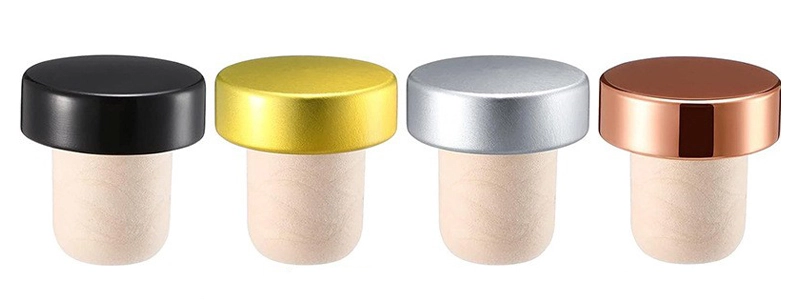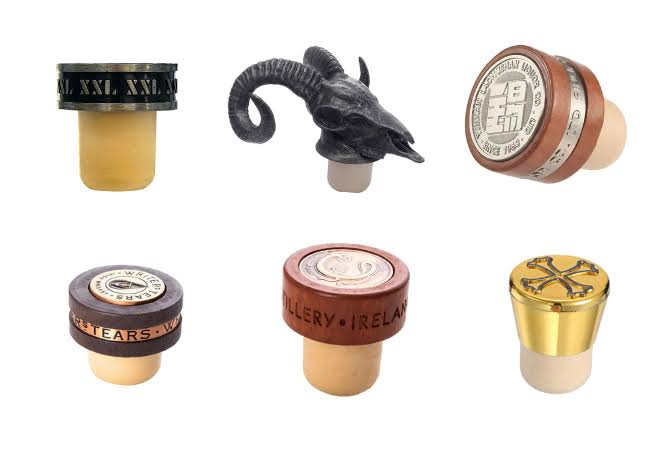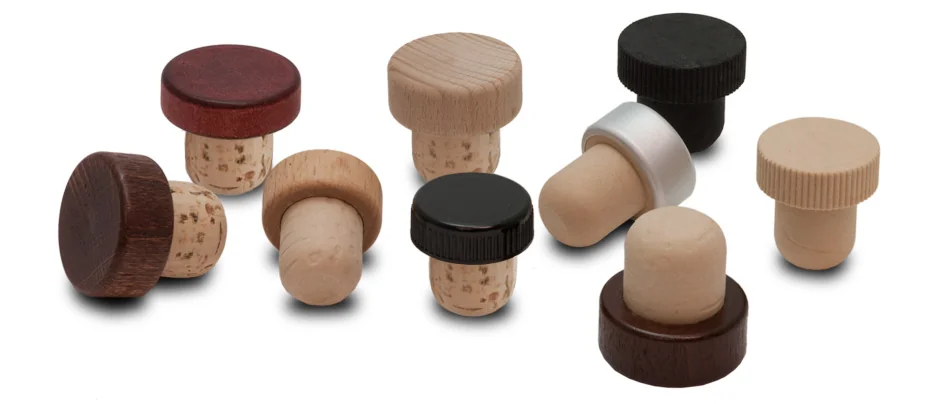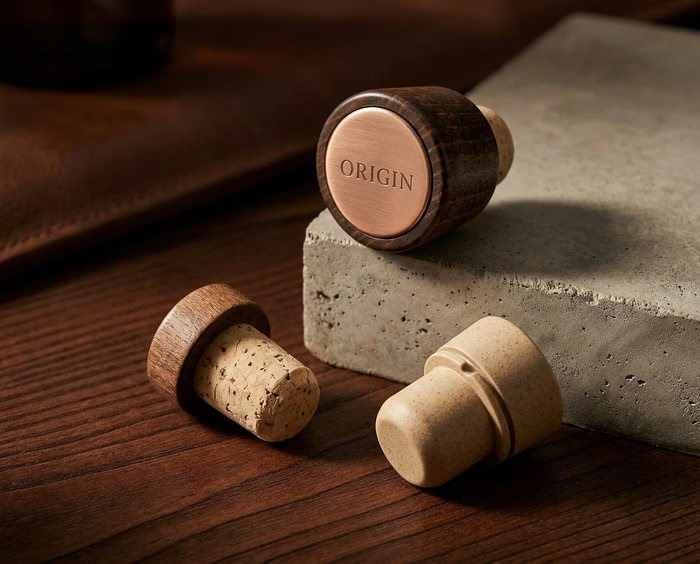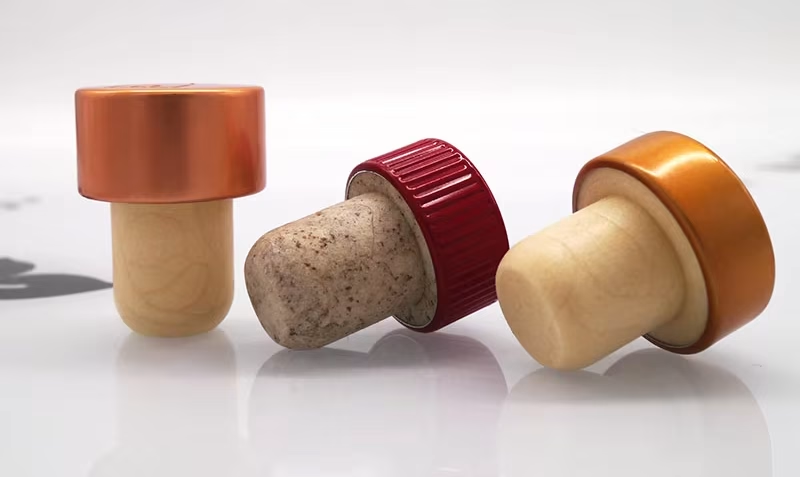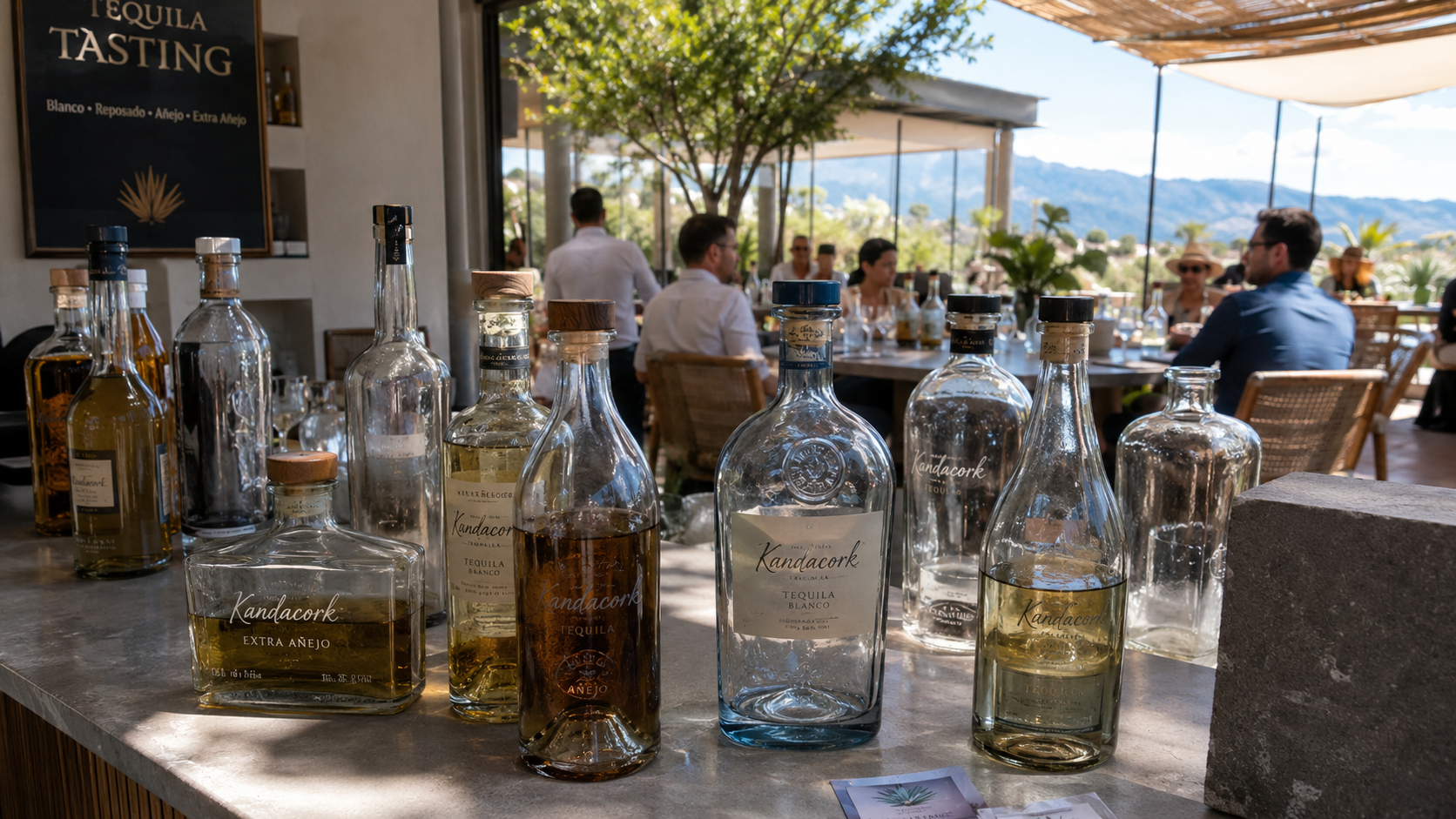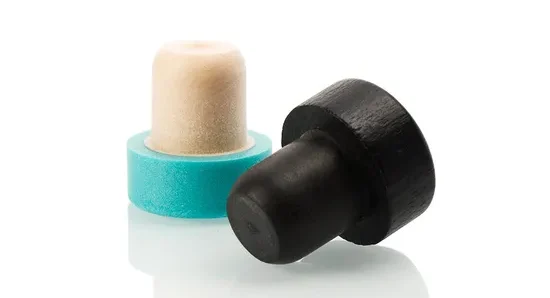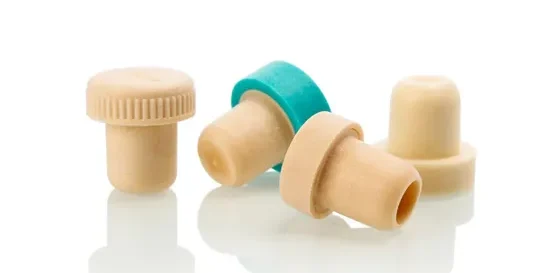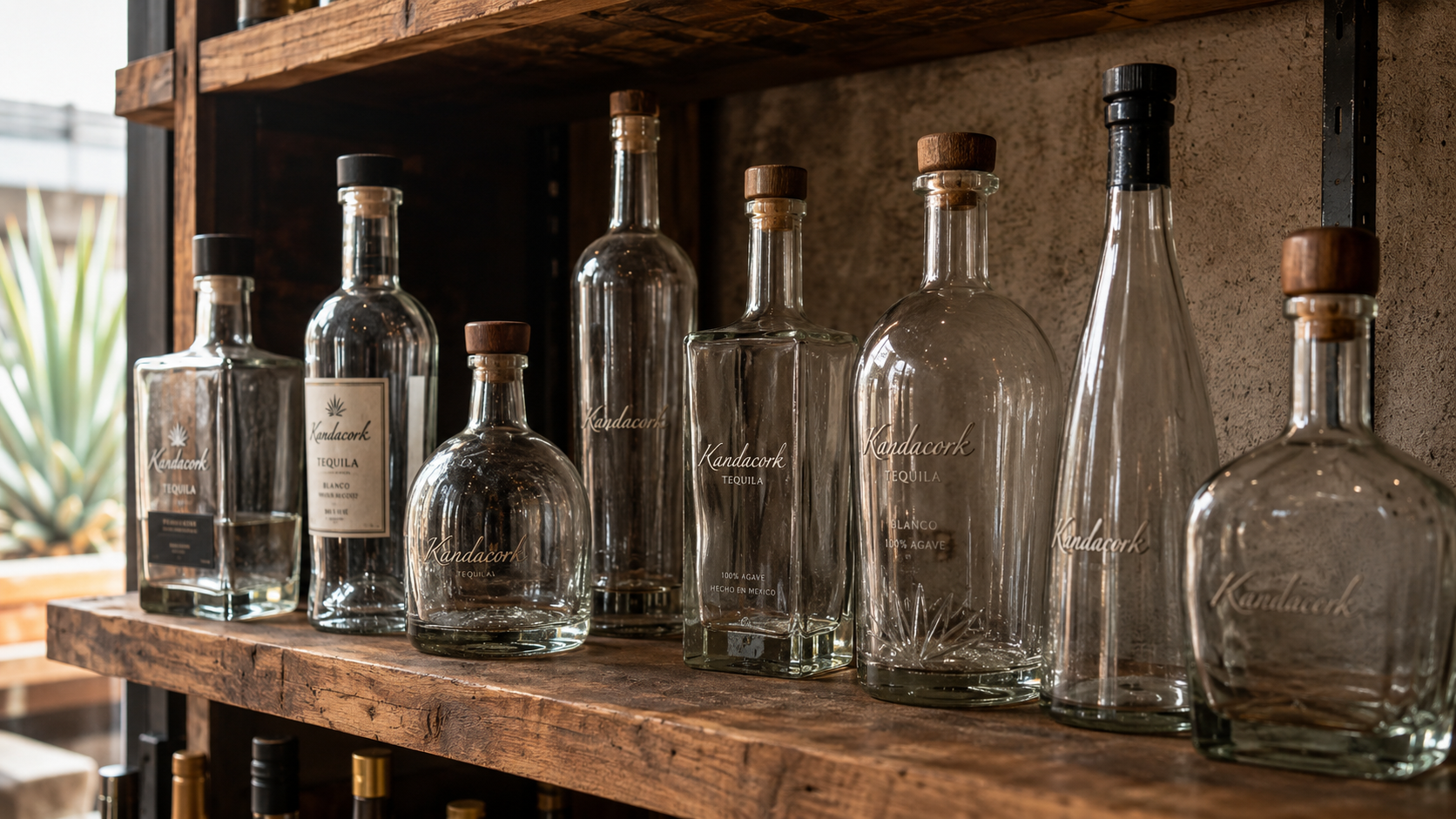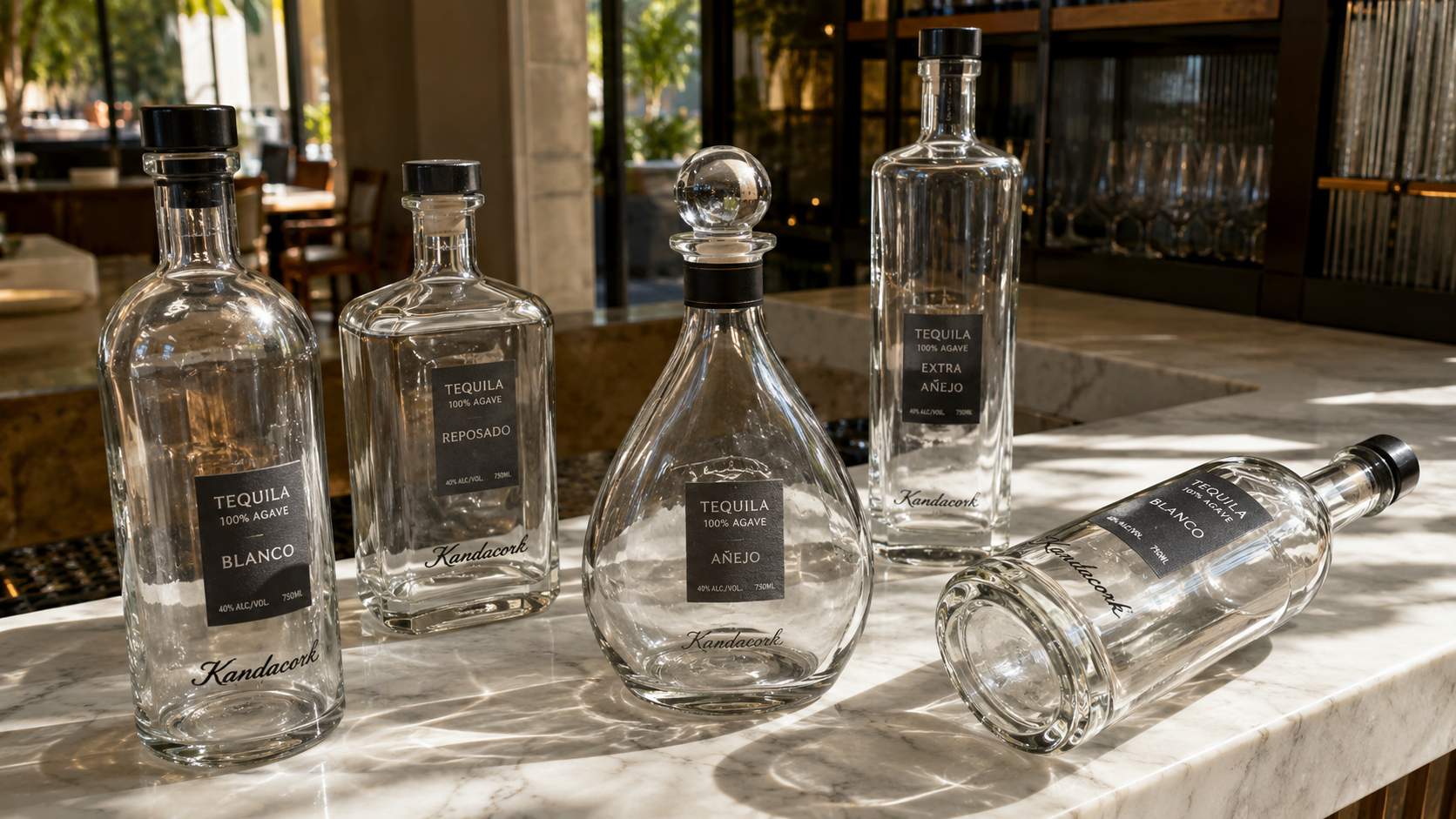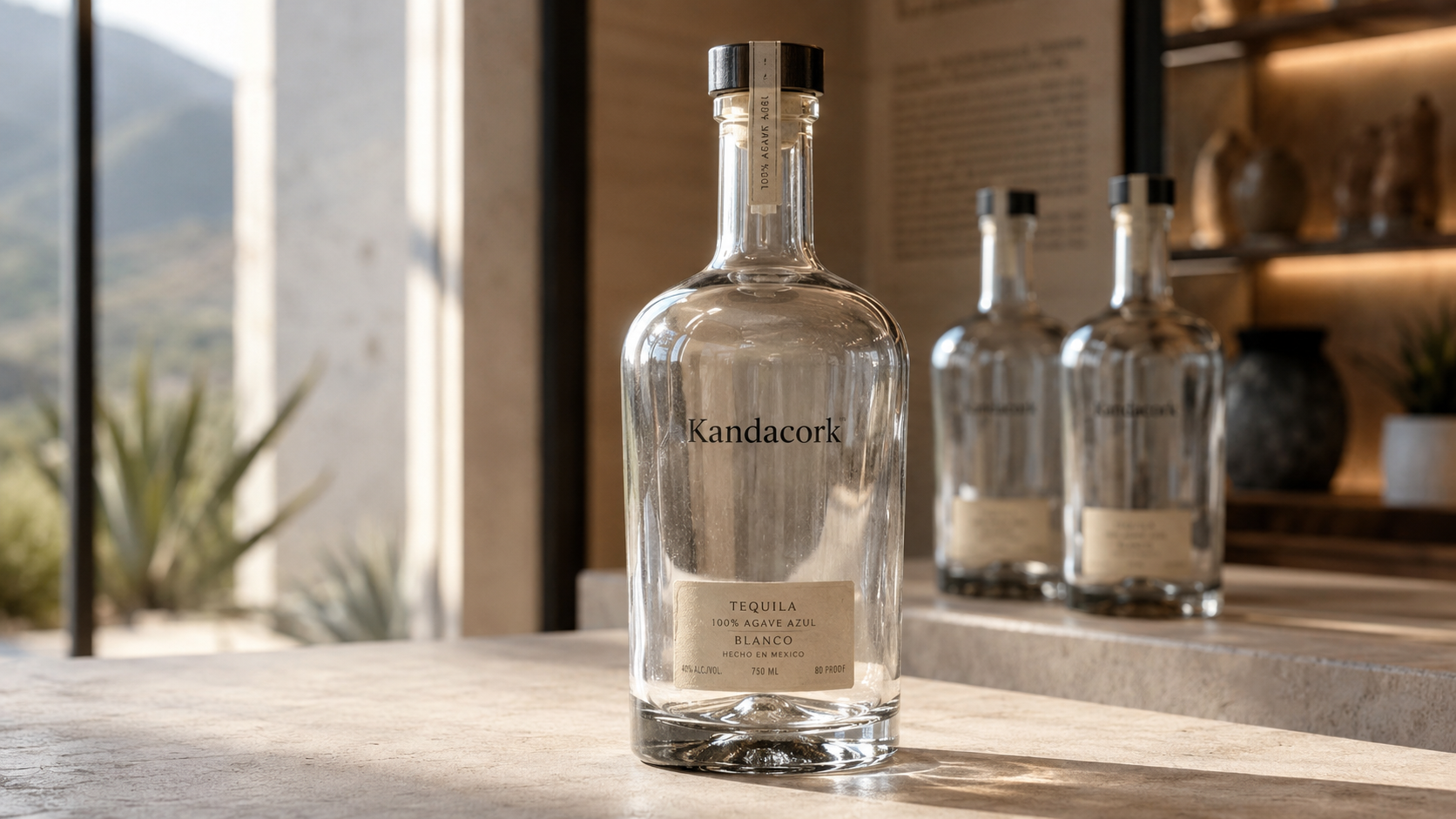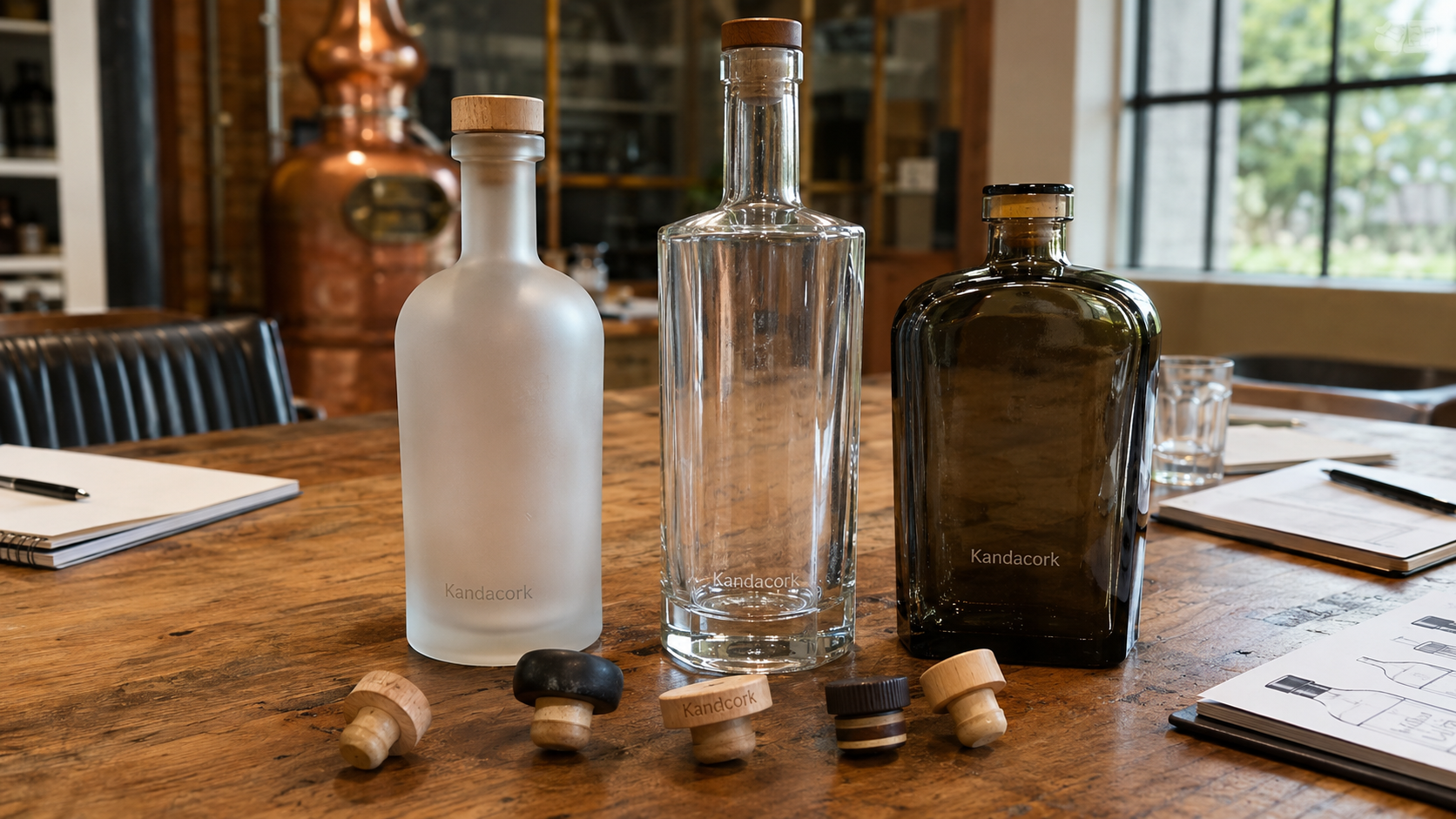
Bar-top closures require careful coordination between top design, shank material, bottle neck fit and branding details. This guide helps buyers prepare the key information needed for sampling, testing and bulk production of spirits bottle bar-top closures.
What Is a Bar-Top Closure?
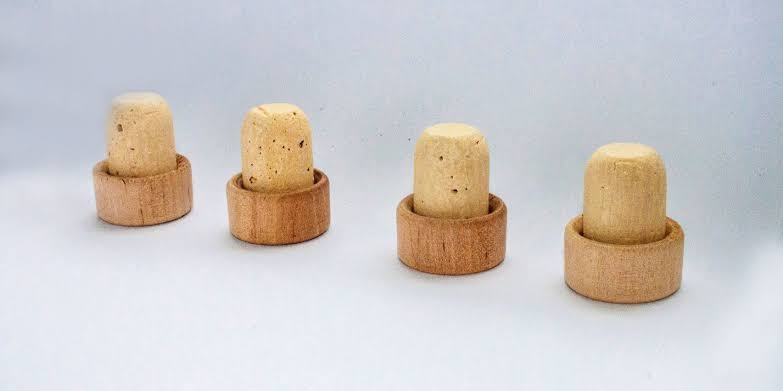
A bar-top closure, also called a T-top stopper or bottle stopper, is a reclosable packaging component made from two main parts: the visible top head and the sealing shank. The top head creates the brand impression, while the shank fits into the bottle neck to provide friction, compression, and sealing performance.
The head can be made from wood, aluminum, plastic, glass, metal, resin, ceramic, or custom molded materials. The shank is commonly made from synthetic cork, natural cork, micro-agglomerated cork, or another engineered sealing material.
Bar-top closures are popular in premium spirits packaging because they are functional, reusable, and visually distinctive. Unlike ordinary caps, they become part of the consumer experience. The customer touches the closure before pouring the product, which makes the stopper a small but powerful brand contact point.
A reliable custom T-top stopper supplier should understand both sides of the product: the closure must look premium and seal correctly. A beautiful stopper that does not fit the neck bore, withstand distribution, or maintain consistent opening force can create leakage, quality complaints, and production delays.
Why Spirits Brands Use Custom Bar-Top Closures
Spirits brands use custom bar-top closures to improve bottle appearance, reinforce brand positioning, and create a better pouring experience. A well-designed stopper can make a standard bottle feel more premium without changing the entire bottle mold.
For craft whisky, a dark stained wooden top can communicate heritage and small-batch character. For a modern gin or vodka, an aluminum top can create a clean and technical appearance. For luxury tequila, rum, or brandy, a heavy glass or metal stopper can support a limited-edition or gift-box presentation.
A bar-top closure supplier for spirits bottles can help brands solve practical and commercial problems, including:
- Improving shelf differentiation in retail, hospitality, and duty-free channels
- Matching the closure with the bottle, label, capsule, carton, and gift box
- Creating a branded top surface for logos, icons, crests, or embossed marks
- Adjusting the shank diameter to match the bottle neck opening
- Testing insertion force, extraction force, and leakage performance
- Supporting repeatable bulk production for ongoing orders
- Preparing export-ready packaging for international shipments
For brands developing a complete spirits packaging system, bottle structure and closure design should be considered together. A supplier such as Kandacork Spirits can support bottle-focused programs where the bottle shape, neck finish, stopper, decoration, and secondary packaging need to work as one coordinated solution.
Bar-Top Closure Material Comparison
The best bar-top closure material depends on the spirit category, brand positioning, bottle neck size, decoration method, target cost, and expected order quantity. A professional custom spirits bottle closure manufacturer should compare both the visible head material and the sealing shank before recommending a final structure.
| Material | Best For | Advantages | Key Considerations |
|---|---|---|---|
| Wood | Whisky, rum, brandy, craft spirits | Natural, warm, tactile, premium | Color variation, moisture control, coating consistency |
| Aluminum | Gin, vodka, tequila, modern spirits | Clean, durable, consistent, premium | Finish quality, anodizing control, logo precision |
| Plastic | Private label, high-volume programs | Cost-effective, lightweight, stable | Less premium unless finished carefully |
| Glass | Luxury spirits and gift sets | High-end appearance, collectible feel | Weight, breakage risk, packing protection |
| Metal or zinc alloy | Limited editions and premium spirits | Strong luxury signal, sculptural design | Mold cost, weight, center of balance |
| Resin or composite | Creative brand shapes | Flexible molding and color effects | Material compatibility and durability testing |
| Natural cork shank | Heritage positioning | Traditional feel, natural elasticity | Natural variation and sensory control |
| Synthetic cork shank | Larger production runs | Dimensional consistency and repeatability | Alcohol compatibility should be verified |
| Micro-agglomerated cork shank | Premium controlled cork option | Balance of natural cork identity and uniformity | Requires clear specification and tolerance control |
Material choice should not be based only on appearance. Buyers should consider the full life cycle of the closure, from sampling and line trials to filling, warehousing, pallet transport, retail display, and consumer reclosure.
For U.S. projects, buyers may also need to confirm whether closure components are suitable for food-contact use. The FDA explains that food-contact substances can include packaging components, adhesives, colorants, and materials that come into contact with food or beverages through normal use, which makes material documentation important for spirits packaging decisions.
Wooden Bar-Top Closures
Wooden bar-top closures are best for whisky, rum, brandy, craft gin, heritage-style liqueurs, and spirits brands that want a natural or handcrafted image. Wood gives the package a warm, tactile character that works well with embossed glass, textured labels, and premium gift boxes.
Kandacork develops custom wooden bar-top stoppers for spirits brands that need a natural top surface, stable bottle fit, and decoration options such as laser engraving, hot stamping, staining, matte coating, and custom shapes.
Common wooden stopper designs include flat tops, domed tops, mushroom profiles, beveled edges, stepped collars, and custom CNC-shaped heads. Finishing options may include natural varnish, dark stain, matte coating, glossy coating, laser engraving, hot stamping, and color matching.
Wood is especially effective when a brand wants to communicate craft, tradition, natural quality, or small-batch production. However, buyers should confirm wood species, moisture control, coating stability, color tolerance, logo clarity, and batch-to-batch consistency before approving bulk production.
A liquor bottle stopper supplier should also explain how the wooden head is assembled with the shank. The bonding method, alignment, and final inspection process all affect durability and user experience.
Aluminum Bar-Top Closures
Aluminum bar-top closures are best for modern gin, vodka, tequila, premium rum, contemporary whisky, and spirits brands that want a clean, precise, and high-value appearance. Aluminum works well for minimalist labels, clear bottles, metallic design systems, and premium retail packaging.
Aluminum bar-top stoppers support brushed finishes, polished surfaces, matte effects, anodized colors, printed logos, laser engraving, embossing, debossing, and decorative inserts. Compared with natural materials, aluminum can provide stronger dimensional consistency and more stable color control across larger production runs.
A custom bar-top closure supplier can pair aluminum heads with synthetic cork, natural cork, or micro-agglomerated cork shanks depending on the bottle neck, target opening feel, and sealing requirement.
Buyers should review finish uniformity, surface scratches, logo tolerance, sharp edges, head weight, and assembly strength during sample approval. If the brand uses metallic labels, foil stamping, capsules, or premium cartons, the aluminum finish should be checked under real lighting conditions to avoid color mismatch.
Plastic and Synthetic Bar-Top Closures
Plastic and synthetic bar-top closures are best for private-label brands, large-volume orders, promotional spirits, and commercial packaging programs that require cost efficiency and stable supply. They are also useful when a brand needs repeatable dimensions, lightweight handling, and controlled unit cost.
Kandacork supplies custom plastic bar-top stoppers for whisky, vodka, gin, rum, tequila, liqueur, and private-label spirits where consistent fit, color flexibility, and repeatable bulk production are important.
Plastic heads can be molded into many shapes and finished with solid colors, metallic coatings, printed logos, inserts, or textured surfaces. When designed well, plastic does not have to look cheap. It can be a strategic choice for consistent production and controlled pricing.
The main advantages are repeatability, lightweight handling, and flexible mold design. However, buyers should confirm resin type, surface durability, color stability, odor control, and compatibility with the intended spirit category.
For high-volume spirits packaging, a premium bottle stopper manufacturer should help balance price, appearance, shank performance, MOQ, and filling-line compatibility.
Luxury Glass, Metal, and Custom Molded Stoppers
Luxury stopper heads are best for flagship products, limited editions, anniversary releases, collector bottles, and premium gift sets. These closures create a stronger visual statement than standard wood or plastic and can support a more memorable brand experience.
Materials may include glass, zinc alloy, metal, resin, ceramic, composite materials, or a custom molded brand icon. These structures can support sculptural shapes, engraved crests, color-filled logos, medallions, and decorative inserts.
Luxury stoppers require careful technical review. Buyers should confirm head weight, center of balance, bottle stability, mold cost, assembly strength, dimensional tolerance, carton protection, and distribution testing. A stopper that looks impressive in a rendering may still fail if it is too heavy, poorly balanced, or difficult to protect during shipping.
For brands developing custom bottles and high-end stopper systems together, Kandacork Glass can support integrated liquor packaging programs where glass bottle design, closure fit, decoration, and export supply need to be coordinated from the beginning.
How to Choose the Right Bar-Top Closure Size
The right bar-top closure size depends on the internal diameter of the bottle neck opening, the shank diameter, the shank material, and the desired opening force. The stopper must compress enough to seal the bottle but not so much that it becomes difficult to insert or remove.
Important sizing terms include:
- Neck bore or inner neck diameter
- Shank diameter
- Shank length
- Cap diameter
- Compression ratio
- Insertion force
- Extraction force or pull-out force
- Neck finish tolerance
- Reclosing performance
Buyers should not select a stopper only from a photo. A bottle drawing, physical bottle sample, or accurate neck measurement is needed before bulk production.
A responsible custom cork stopper supplier will usually recommend physical fit testing before confirming mass production. Testing should include insertion force, pull-out force, leakage risk, reclosure feel, visual alignment, and performance after transport simulation.
Bar-Top Closure Sizing Checklist
A sizing checklist helps buyers avoid common fit problems before ordering samples or approving bulk production. The most important goal is to match the shank diameter and compression behavior to the actual bottle neck, not only to the nominal bottle size.
| Buyer Should Check | Why It Matters |
|---|---|
| Bottle neck inner diameter | Determines the correct shank diameter |
| Neck finish drawing | Confirms tolerance and fit details |
| Bottle sample | Allows real insertion and leakage testing |
| Alcohol strength | Helps evaluate material compatibility |
| Filling method | Affects closure application and line handling |
| Capping equipment | Ensures production compatibility |
| Desired opening feel | Controls consumer experience |
| Storage conditions | Supports long-term performance |
| Shipping method | Helps assess leakage and packing risk |
If the closure is too loose, leakage or weak reclosure may occur. If it is too tight, insertion problems, bottle damage, or poor consumer experience may result. The best fit is confirmed through testing, not guesswork.
Glass is often selected for spirits packaging because it supports premium presentation, product visibility, and recyclability. The Glass Packaging Institute describes glass packaging as a major material choice for container manufacturers, sustainability programs, and packaging professionals, which makes closure compatibility with glass bottle design an important part of the buying process.
Customization Options for Spirits Brands
Customization turns a bottle stopper into a brand asset. The top surface of the closure can carry a logo, symbol, crest, product line mark, limited-edition number, or decorative texture.
Common customization options include:
- Laser engraving
- Hot foil stamping
- Screen printing
- UV printing
- Embossing
- Debossing
- Metal inserts
- Coin-style medallions
- Color matching
- Matte or glossy coating
- Wood staining
- Anodized aluminum effects
- Custom molded head shapes
- Brand-specific icons or sculptural details
The decoration method should match the material and artwork. Laser engraving works well on wood and some metals. Hot stamping can create a premium metallic logo. Embossing and debossing are useful for crests, monograms, and heritage marks. UV printing or screen printing may be better for multi-color artwork.
A custom bar-top closure supplier should review the logo safe zone before production. Thin lines, tiny letters, complex gradients, and very small details may need to be adjusted for a stopper head.
For brands that need coordinated bottle graphics, closure decoration, screen printing, spraying, or premium visual effects, Kandacork Decor can support branding programs where the stopper, bottle surface, label, and secondary packaging need to present one consistent identity.
Matching the Closure with the Full Bottle Design
A bar-top closure should be developed as part of the complete bottle design, not as a separate accessory. The stopper should match the bottle shape, label style, capsule, carton, gift box, product price point, and target retail channel.
For a premium whisky, a dark wooden bar-top stopper may pair well with amber glass, textured labels, and a rigid box. For a modern gin, brushed aluminum may match clear glass and minimal typography. For tequila or mezcal, a custom molded stopper can support a more expressive brand story.
Buyers should consider:
- Bottle shoulder shape
- Neck height
- Label material and color
- Capsule or shrink sleeve
- Carton and gift box design
- Target retail price
- Target market expectations
- Competitor packaging on the shelf
- Product photography and e-commerce display
- Unboxing and pouring experience
A custom bar-top closure supplier should ask for brand context, not just dimensions. The best closure is one that looks correct on the final bottle and performs correctly in production.
Quality Control for Custom Bar-Top Closures
Quality control should be defined before production begins because a bar-top closure combines material sourcing, head shaping, surface finishing, logo decoration, shank production, assembly, packing, and export handling. Clear inspection standards reduce the risk of leakage, appearance defects, poor fit, and delayed shipments.
Important quality control points include:
- Raw material inspection
- Head diameter and height measurement
- Shank diameter and length measurement
- Dimensional tolerance control
- Surface finish consistency
- Logo position and clarity
- Adhesion between head and shank
- Odor and sensory checks
- Ethanol resistance review
- Insertion force testing
- Pull-out force testing
- Leakage or inversion testing
- Reclosing performance
- Carton strength and pallet stability
- Final random inspection before shipment
For food-contact materials sold into the European market, the European Commission explains that Regulation (EC) No 1935/2004 provides a harmonized framework based on safety and inertness for food-contact materials. For spirits closures, this makes material selection, declarations, and supplier documentation important parts of the sourcing process.
For bulk inspection, buyers and suppliers may use sampling concepts from ISO 2859-1, which covers sampling procedures for inspection by attributes. For packaging transport performance, ASTM D4169 provides a recognized framework for evaluating shipping units under distribution-related test conditions. These standards help purchasing teams, quality engineers, and suppliers communicate expectations more clearly.
RFQ Information Checklist
A clear RFQ helps a custom bar-top closure supplier recommend the right structure and provide a more accurate quotation. It also reduces back-and-forth communication, shortens sampling time, and helps prevent costly fit or decoration mistakes.
| Information to Provide | Why It Helps |
|---|---|
| Bottle drawing | Confirms neck bore, height, and tolerance |
| Physical bottle sample | Enables fit, leakage, and opening-feel testing |
| Existing stopper sample | Helps match or improve current performance |
| Spirit type | Supports material and sensory review |
| Alcohol strength | Helps evaluate compatibility |
| Target head material | Controls appearance and cost |
| Target shank material | Affects sealing and opening force |
| Logo artwork | Determines decoration method |
| Desired finish | Guides coating, color, and surface treatment |
| Estimated order quantity | Affects MOQ, tooling, and unit price |
| Target market | Helps prepare compliance documents |
| Delivery schedule | Determines production and sampling plan |
Send your bottle drawing and target order quantity early to confirm the correct shank size, material options, MOQ, sample cost, and estimated lead time.
Common Mistakes When Choosing Bar-Top Closures
Many closure problems happen because buyers focus only on appearance or price. A good-looking stopper may still fail if it does not match the neck bore, filling line, storage conditions, or shipping environment.
Common mistakes include:
- Choosing a stopper without measuring the bottle neck
- Approving a design without physical samples
- Ignoring shank diameter tolerance
- Selecting a decorative head that is too heavy
- Using artwork that is too detailed for the stopper surface
- Forgetting to test leakage after transport
- Comparing suppliers only by unit price
- Not confirming MOQ, mold cost, and lead time early
- Ignoring odor, sensory neutrality, and food-contact requirements
- Failing to check carton strength for export shipments
A professional custom bar-top closure supplier should help identify these risks before mass production.
For brands looking at broader packaging sustainability, lightweighting, recycled-content glass, or multi-category glass packaging development, Kandacork Eco Glass can support packaging programs where closure choice, glass structure, decoration, and export logistics need to be considered together.
Custom Bar-Top Closure Supplier vs. Generic Stopper Distributor
A custom bar-top closure supplier is better for branded spirits projects that require material selection, bottle-neck matching, logo decoration, sample development, and repeatable bulk production. A generic stopper distributor may be useful for simple stock closures, but it usually provides less technical and brand-development support.
| Supplier Type | Best For | Limitations |
|---|---|---|
| Generic stopper distributor | Small orders, standard bottles, quick replacement | Limited customization and technical support |
| Custom bar-top closure supplier | Branded spirits bottles, premium packaging, bulk production | Requires more project details and sample approval |
| Packaging trading company | Mixed packaging procurement | May have less direct control over production details |
| Factory-direct closure manufacturer | Custom structures and repeat orders | Usually requires MOQ and development time |
For serious spirits packaging projects, working with a custom supplier is usually more effective than buying a generic stopper based only on size and price.
Buyer Decision Summary
This summary helps buyers quickly match their packaging goal with the right closure development focus.
| Buyer Goal | Recommended Focus |
|---|---|
| Premium natural appearance | Wooden top with natural, stained, matte, or engraved finish |
| Modern luxury look | Aluminum top with brushed, polished, anodized, or laser-marked finish |
| Consistent bulk production | Synthetic cork or engineered shank with controlled tolerance |
| Heritage-style positioning | Wood or natural cork elements with classic decoration |
| Luxury limited edition | Custom molded glass, resin, ceramic, or metal head |
| Fast sampling | Standard mold with logo decoration and existing shank sizes |
| Stronger sealing confidence | Bottle sample testing, pull-out force review, and leakage checks |
| Better export stability | Carton strength, pallet protection, and final random inspection |
| More accurate quotation | Complete RFQ with bottle drawing, artwork, quantity, and target market |
This decision table can also help purchasing teams, design teams, and packaging engineers align before sending an inquiry.
MOQ, Lead Time, and Project Workflow
A clear workflow helps buyers understand how a custom closure project moves from idea to bulk shipment. The exact timeline depends on material, decoration method, mold requirements, order quantity, and sample approval speed.
Share Bottle and Brand Information
The buyer provides bottle drawings, bottle samples, neck dimensions, spirit category, alcohol strength, logo files, design references, estimated order quantity, target market, and expected delivery schedule.
Select Material and Structure
The supplier recommends the head material, shank material, cap diameter, shank diameter, decoration method, surface finish, and packing method. If a standard mold is suitable, development can move faster. If a new mold is needed, tooling cost and development time should be confirmed early.
Develop and Review Samples
Samples allow the buyer to check appearance, fit, opening feel, logo quality, color, surface finish, and bottle compatibility. Physical samples are especially important for custom colors, natural wood finishes, metal effects, and luxury molded shapes.
Confirm Bulk Production Details
After sample approval, both sides confirm MOQ, lead time, artwork, tolerance, inspection standard, packing method, carton labels, shipping terms, and documentation requirements.
Inspect and Ship
Before shipment, the supplier checks dimensions, finish, assembly strength, logo quality, carton condition, and packing accuracy. Export cartons should be suitable for long-distance transportation and pallet handling.
How to Evaluate a Custom Bar-Top Closure Supplier
A strong supplier should understand spirits packaging, not only generic closures. The supplier should ask technical questions because the stopper must fit, seal, look correct, and support repeatable production.
Use this checklist before selecting a custom bar-top closure supplier:
- Does the supplier understand spirits bottle neck sizing?
- Can they work from drawings or physical bottle samples?
- Can they support wood, aluminum, plastic, glass, metal, and synthetic options?
- Can they recommend the right shank material?
- Do they offer decoration methods such as engraving, printing, embossing, debossing, or hot stamping?
- Can they support custom mold development?
- Do they provide pre-production samples?
- Can they discuss food-contact documentation and material safety?
- Do they perform fit, leakage, appearance, and assembly checks?
- Can they support bulk export packing?
- Do they communicate clearly about MOQ, tooling, and lead time?
A supplier that only asks for quantity and target price may not be the right partner for premium spirits packaging. A better supplier helps reduce packaging risk before production begins.
Why Work with Kandacork Closures
Kandacork Closures helps spirits brands and packaging buyers develop bar-top stoppers that combine sealing performance, brand appearance, and production practicality.
As a custom bar-top closure supplier, Kandacork Closures can support wooden stoppers, aluminum stoppers, plastic stoppers, metal stopper heads, synthetic cork shanks, natural cork shanks, micro-agglomerated cork shanks, and project-based custom structures. Buyers can explore the wider bottle stoppers and closures range to compare bar-top stoppers, screw caps, ROPP closures, capsules, shrink sleeves, and specialty closure systems.
For premium spirits brands, Kandacork Closures can help match the stopper with the bottle neck, label style, capsule, gift box, and target retail positioning. For distributors and contract bottlers, the focus is repeatable quality, clear communication, export-ready packing, and stable supply.
The result is a closure program that looks premium, fits correctly, and supports commercial production.
FAQ
What is a custom bar-top closure?
A custom bar-top closure is a bottle stopper designed with a specific head material, shape, color, logo, and shank size for a brand or bottle project. It is commonly used for spirits bottles because it combines reclosable function with premium branding.
What is the difference between a bar-top closure and a screw cap?
A bar-top closure uses a stopper shank that fits into the bottle neck by friction. A screw cap uses threads to close the bottle. Bar-top closures are often selected for premium whisky, rum, brandy, tequila, and craft spirits, while screw caps are common for threaded bottle systems and certain high-speed filling lines.
How do I know which shank size fits my bottle?
Measure the internal diameter of the bottle neck opening and test a shank that provides the right compression and opening force. Physical testing is recommended before bulk production because bottle neck tolerance and shank material both affect the final fit.
Which material is best for premium spirits closures?
Wood is popular for heritage and craft spirits. Aluminum is suitable for modern premium spirits. Metal, glass, and resin heads are often used for luxury or limited-edition bottles. Plastic and synthetic heads can be effective for high-volume projects with cost targets.
Can I customize the logo on a bar-top closure?
Yes. Logo options include laser engraving, hot stamping, screen printing, UV printing, embossing, debossing, metal inserts, and molded details. The best method depends on the head material, artwork complexity, budget, and order quantity.
Can Kandacork Closures provide samples before bulk production?
Yes. Sample development is recommended before bulk production so the buyer can confirm appearance, bottle fit, opening feel, logo quality, color, finish consistency, and production feasibility.
What information should I send for a quotation?
Send the bottle drawing or bottle sample, neck size, product type, target material, logo artwork, desired finish, order quantity, packaging requirements, target market, and expected delivery schedule. This helps the supplier recommend the right structure and provide a more accurate quotation.
What is the typical MOQ for custom bar-top closures?
MOQ depends on material, mold requirements, decoration method, and order complexity. Standard structures usually have lower MOQ than fully custom molded heads, luxury metal parts, or special color-matched finishes.
Conclusion
A bar-top closure is a small packaging component with a major impact on brand perception and product performance. The right stopper can help a spirits bottle look more premium, feel more memorable, and seal more reliably.
When choosing a custom bar-top closure supplier, do not evaluate only the unit price. Compare material options, sizing support, decoration methods, quality control, food-contact documentation, sample development, MOQ, lead time, and export capability.
Kandacork Closures works with spirits brands, distilleries, bottlers, and packaging distributors to develop custom bar-top closures for premium bottle programs. Share your bottle drawing, sample, logo artwork, target material, and order quantity through the custom closure quote page to receive a tailored closure recommendation, sample plan, MOQ, and lead time.