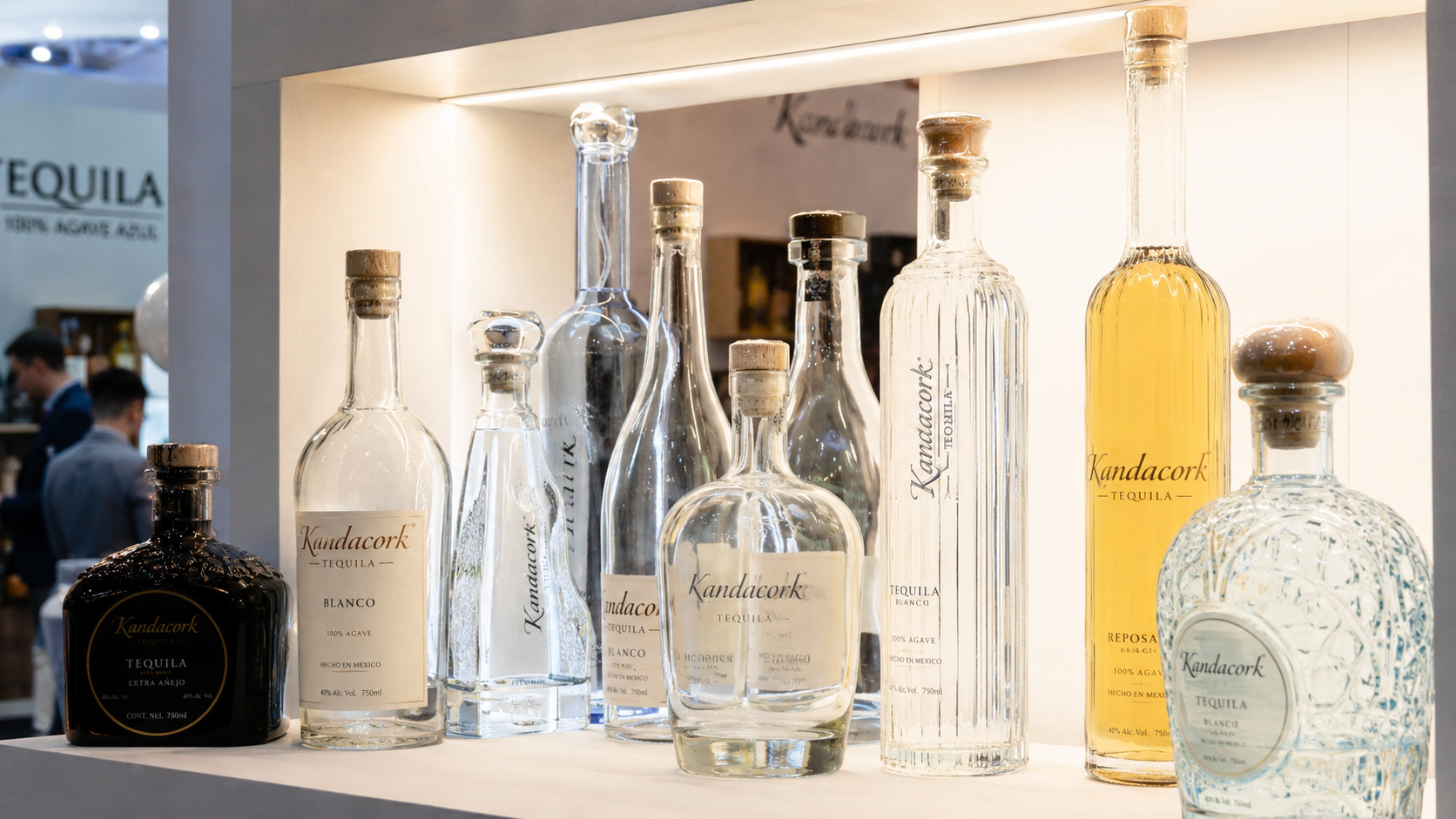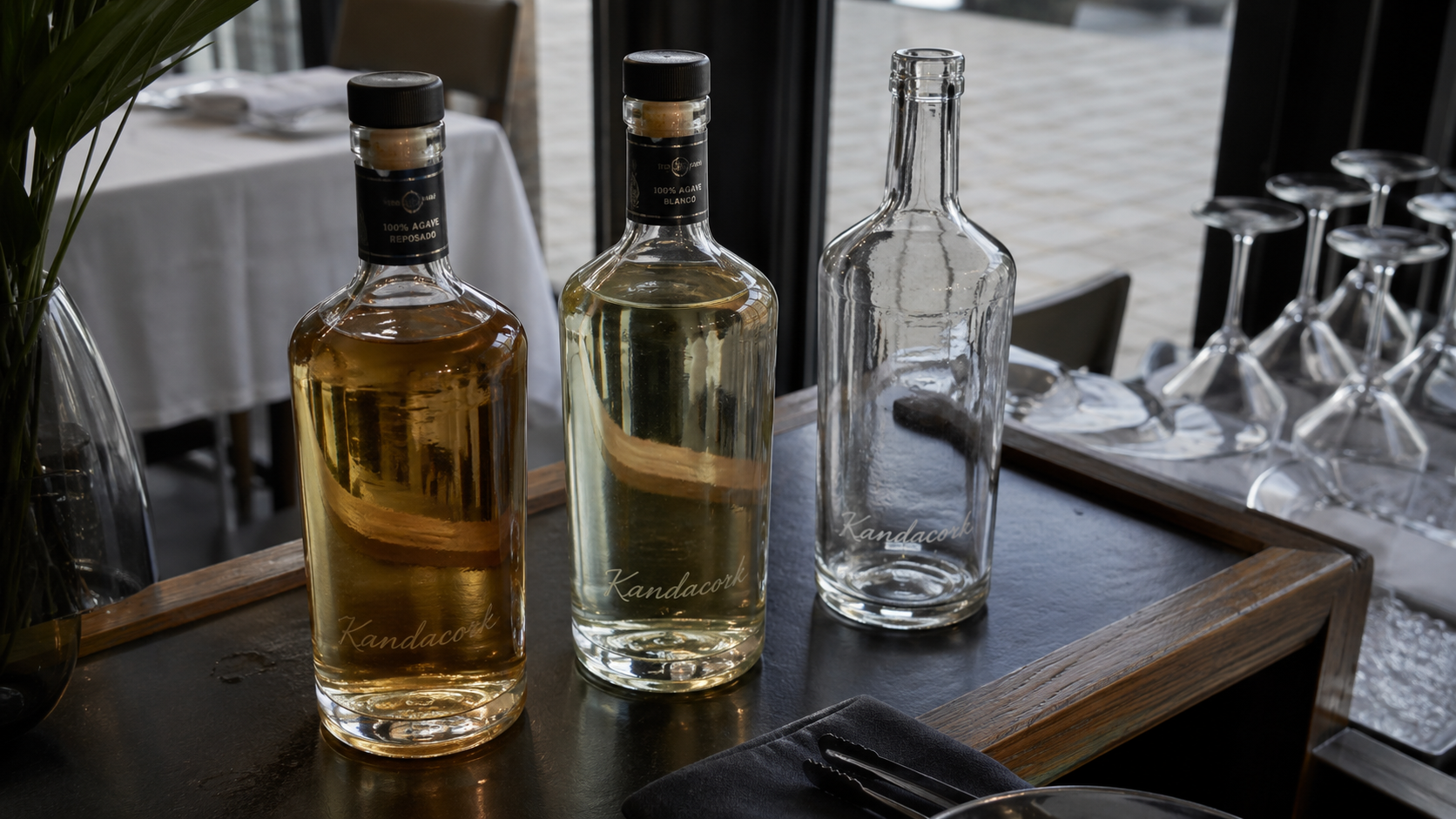
Rum bottle closure options vary by product tier, bottle shape, export market and brand style. This guide helps buyers compare cork stoppers, bar-top closures, metal tops, screw caps and ROPP caps before selecting a closure system.
Request a Quote for Custom Rum Bottle Closures
To receive a faster quote, send your bottle drawing, neck finish, closure type, logo artwork, target material, estimated order quantity, destination market, and launch timeline. If possible, provide a physical bottle sample so the closure can be checked for fit, leakage resistance, pull-out force, torque performance, and filling-line compatibility.
A practical RFQ should include:
- Bottle drawing or physical sample
- Neck inner diameter and outer diameter
- Neck finish or thread profile
- Preferred closure type
- Head material and shank material
- Logo artwork and decoration method
- Required color, plating, texture, or finish
- Estimated annual order volume
- Filling-line method and speed
- Destination market and compliance needs
- Target delivery schedule
For buyers comparing different spirits packaging systems, the broader bottle stoppers and closures range is a useful starting point because it covers bar-top stoppers, screw caps, ROPP closures, capsules, sleeves, and non-refillable solutions.
Why Rum Brands Need the Right Bottle Closure
The right rum bottle closure protects the liquid, supports brand identity, and helps prevent packaging problems such as leakage, loose fit, poor resealing, difficult opening, and inconsistent consumer experience.
Rum packaging has to balance function and emotion. A closure must perform reliably during filling, storage, export shipping, retail display, and repeated opening. At the same time, it must make the bottle feel aligned with the spirit inside.
White rum, dark rum, spiced rum, aged rum, craft rum, and luxury sipping rum often require different closure strategies. A premium aged rum may benefit from a wooden bar-top cork that feels warm and traditional. A limited-edition bottle may need a heavier metal or zamac stopper. An export-focused SKU may require a ROPP cap or non-refillable closure for tamper evidence and brand protection.
In the United States, rum is classified under federal distilled spirits standards. The eCFR rum standard defines rum as a recognized class of distilled spirits, which makes bottle labeling, closure compatibility, and packaging compliance important for brands entering regulated markets.
A successful closure should help answer several practical buyer questions:
- Does the closure match the bottle neck finish?
- Can it reduce leakage during transport?
- Does it reseal properly after opening?
- Is it compatible with the bottling line?
- Does it support the product’s retail price point?
- Can it carry the brand’s logo, color, and visual system?
- Does it support tamper evidence or anti-counterfeit protection if required?
For premium rum brands, the closure is often the first physical touchpoint between the consumer and the product. The weight, texture, sound, pull-out force, and finish can all influence perceived quality.
Best Custom Bottle Closures for Different Rum Products
Different rum products need different closure systems. The best option depends on the brand story, retail channel, target price, production volume, filling method, and security requirements.
| Rum Product Type | Recommended Closure | Why It Works |
|---|---|---|
| White rum | ROPP cap or screw cap | Cost-efficient, scalable, and suitable for high-volume filling |
| Spiced rum | Screw cap, bar-top cork, or custom stopper | Supports resealing and flavor-focused branding |
| Dark rum | Wooden stopper or metal T-top stopper | Creates stronger shelf impact and premium appeal |
| Aged rum | Bar-top cork, wooden stopper, or zamac stopper | Matches traditional premium spirits packaging |
| Craft rum | Wooden stopper or synthetic cork stopper | Communicates small-batch quality and natural texture |
| Luxury rum | Metal, zamac, glass, or crystal-style stopper | Adds weight, collectible value, and high-end presentation |
| Mini rum bottles | Screw cap or small ROPP cap | Practical for small formats and efficient filling |
| Export rum | ROPP cap or non-refillable closure | Supports tamper evidence, security, and logistics |
| Gift-pack rum | Wooden, metal, or decorative stopper with capsule | Improves visual consistency and gift value |
A closure should not be selected by appearance alone. It should be tested with the actual bottle, liquid, filling process, packaging carton, and shipping conditions.
Main Types of Custom Rum Bottle Closures
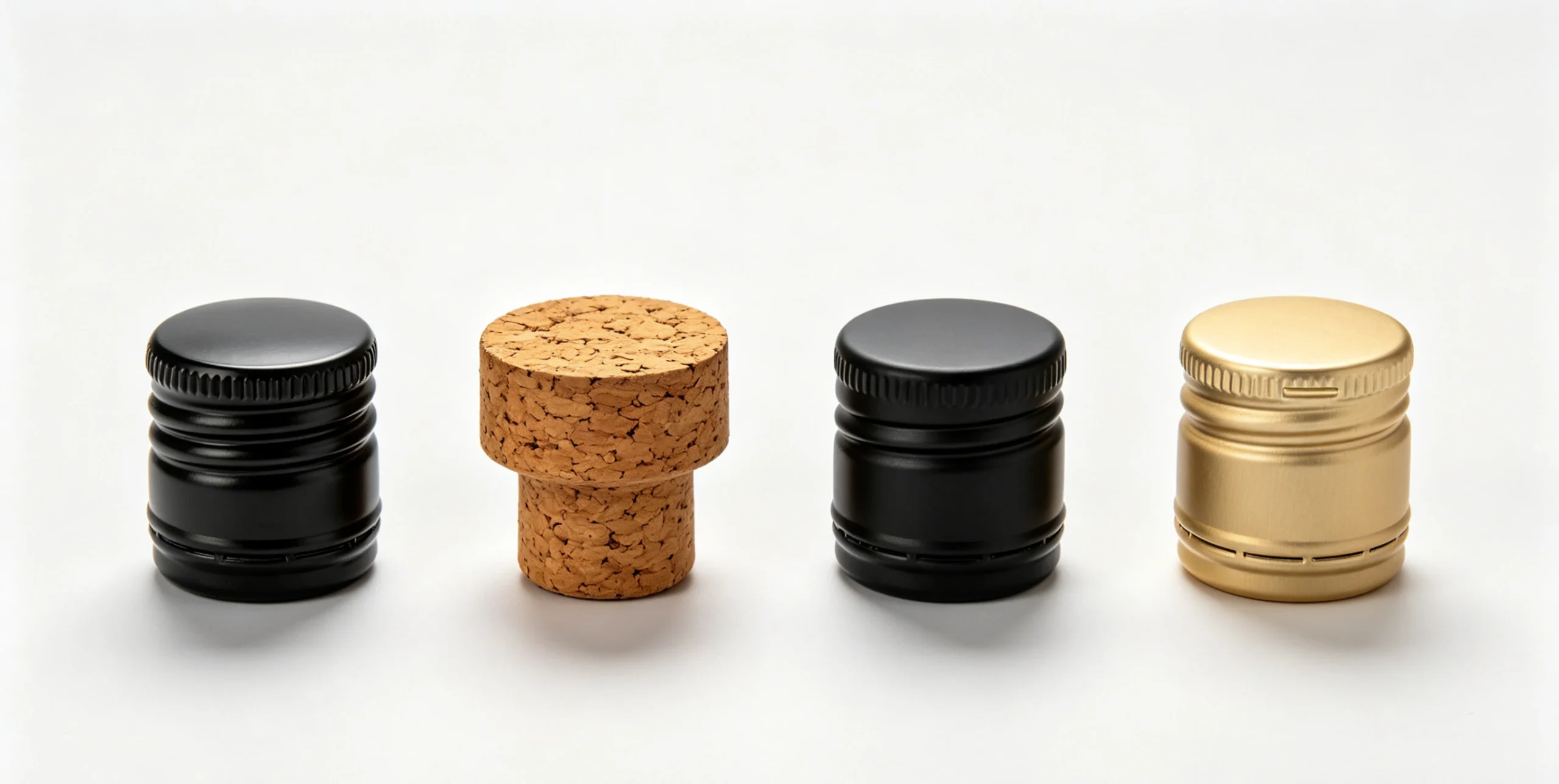
The main custom rum bottle closures include bar-top corks, wooden stoppers, metal stoppers, zamac stoppers, synthetic corks, ROPP caps, screw caps, non-refillable closures, capsules, and shrink sleeves.
| Closure Type | Best For | Key Advantages | Buyer Considerations |
|---|---|---|---|
| Bar-top cork / T-top stopper | Premium rum, aged rum, craft rum | Classic spirits look, resealable, strong hand feel | Requires accurate shank sizing and fit testing |
| Wooden stopper | Craft rum, aged rum, natural-positioned brands | Warm texture, engraving options, traditional appearance | Wood grain, tone, and finish consistency should be controlled |
| Metal stopper | Luxury rum, limited editions, gift packaging | Heavy feel, metallic finish, strong shelf impact | Higher decoration and tooling requirements |
| Zamac stopper | High-end rum and collectible bottles | Custom shape, sculptural design, premium weight | Best for higher-value packaging projects |
| Synthetic cork stopper | Bulk spirits production | Consistent dimensions and stable performance | Must be checked for alcohol compatibility and neck fit |
| Natural cork shank | Traditional premium rum packaging | Natural material story and classic closure feel | Natural variation should be managed |
| ROPP cap | Export rum and high-speed bottling | Secure sealing, tamper evidence, production efficiency | Requires compatible bottle thread and capping equipment |
| Screw cap | White rum, flavored rum, mini bottles | Convenient, resealable, cost-efficient | Liner, torque, and thread engagement are important |
| Non-refillable closure | Premium export rum and anti-counterfeit projects | Helps reduce refilling and tampering risk | More complex structure and higher cost |
| Capsule or shrink sleeve | Premium finish and tamper evidence | Improves neck presentation and security | Must match bottle, closure, and label design |
Many premium projects combine several components. A rum bottle may use a wooden T-top stopper with a synthetic shank, a branded capsule, a tamper-evident sleeve, and a decorated top surface. This creates a complete packaging system rather than a single closure component.
Closure Selection by Buyer Priority
The right closure depends on whether the buyer values premium appearance, filling efficiency, security, cost control, resealability, or decoration flexibility.
| Buyer Priority | Best Closure Option |
|---|---|
| Premium shelf appeal | Wooden stopper, metal stopper, zamac stopper |
| High-speed filling | ROPP cap or screw cap |
| Anti-counterfeit protection | Non-refillable closure |
| Gift-pack presentation | Wooden, metal, glass, or crystal-style stopper |
| Cost control | Screw cap or standard ROPP cap |
| Craft brand identity | Wooden bar-top cork |
| Luxury rum positioning | Zamac or heavy metal stopper |
| Export logistics | ROPP cap, screw cap, or non-refillable closure |
| Resealability | Bar-top cork, T-top stopper, or screw cap |
| Strong decoration surface | Wooden, metal, zamac, or synthetic stopper |
For premium and craft rum, custom wooden bar-top stoppers are often selected because they combine warmth, tactile appeal, logo decoration, and a traditional spirits opening experience.
Bar-Top Corks and T-Top Stoppers for Premium Rum
Bar-top corks and T-top stoppers are suitable for premium rum because they combine resealability, hand feel, visual appeal, and a familiar spirits opening ritual.
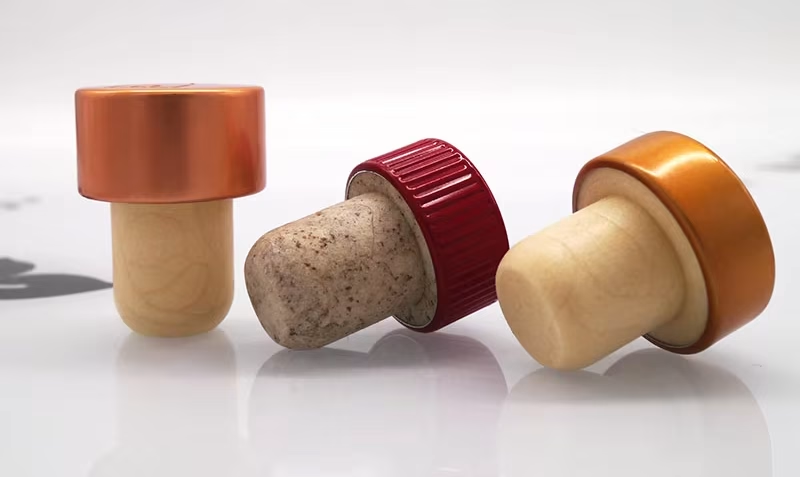
A typical bar-top closure includes a head and a shank. The head may be made from wood, metal, zamac, plastic, glass, or composite material. The shank may be natural cork, micro-agglomerated cork, or synthetic cork. The shank enters the bottle neck and creates the seal.
Key technical points include:
- Bottle neck inner diameter
- Closure head diameter
- Shank diameter
- Shank length
- Insertion depth
- Pull-out force
- Resealing performance
- Leakage resistance
- Alcohol resistance
- Capping-line compatibility
- Storage and transport stability
The shank is commonly selected slightly larger than the bottle neck opening to create compression and sealing force. However, the final size should always be confirmed through sample testing. Glass tolerance, cork material, synthetic shank hardness, storage temperature, humidity, and filling-line pressure can all affect performance.
For premium rum packaging, the opening experience matters. A closure that feels too loose can reduce consumer confidence. A closure that is too tight may be difficult to open. The goal is a controlled, reliable pull-out force that feels secure and premium.
Wooden, Metal, and Luxury Stoppers for Rum Brand Identity
Wooden, metal, zamac, glass, and crystal-style stoppers help rum brands create stronger shelf impact and a more premium opening experience.
Rum is a highly visual category. Packaging often communicates origin, barrel aging, tropical ingredients, craft distillation, heritage, or luxury positioning. The closure should support the same story as the bottle, label, capsule, and outer carton.
Wooden Stoppers for Craft and Aged Rum
Wooden stoppers are a strong choice for craft rum and aged rum because they create a warm, natural, and traditional look. They can be customized with different shapes, stains, surface finishes, and logo decoration methods.
Common decoration options include laser engraving, debossing, hot stamping, color staining, and top logo marking. A dark walnut-style wood top may suit an aged reserve rum, while a lighter natural wood top may fit a craft or tropical-style rum brand.
Wooden closures also work well when a brand wants to communicate barrel aging, authenticity, small-batch production, or natural materials. For rum bottles sold in gift boxes, a wooden stopper can improve the perceived value of the full packaging set.
Metal and Zamac Stoppers for Luxury Rum
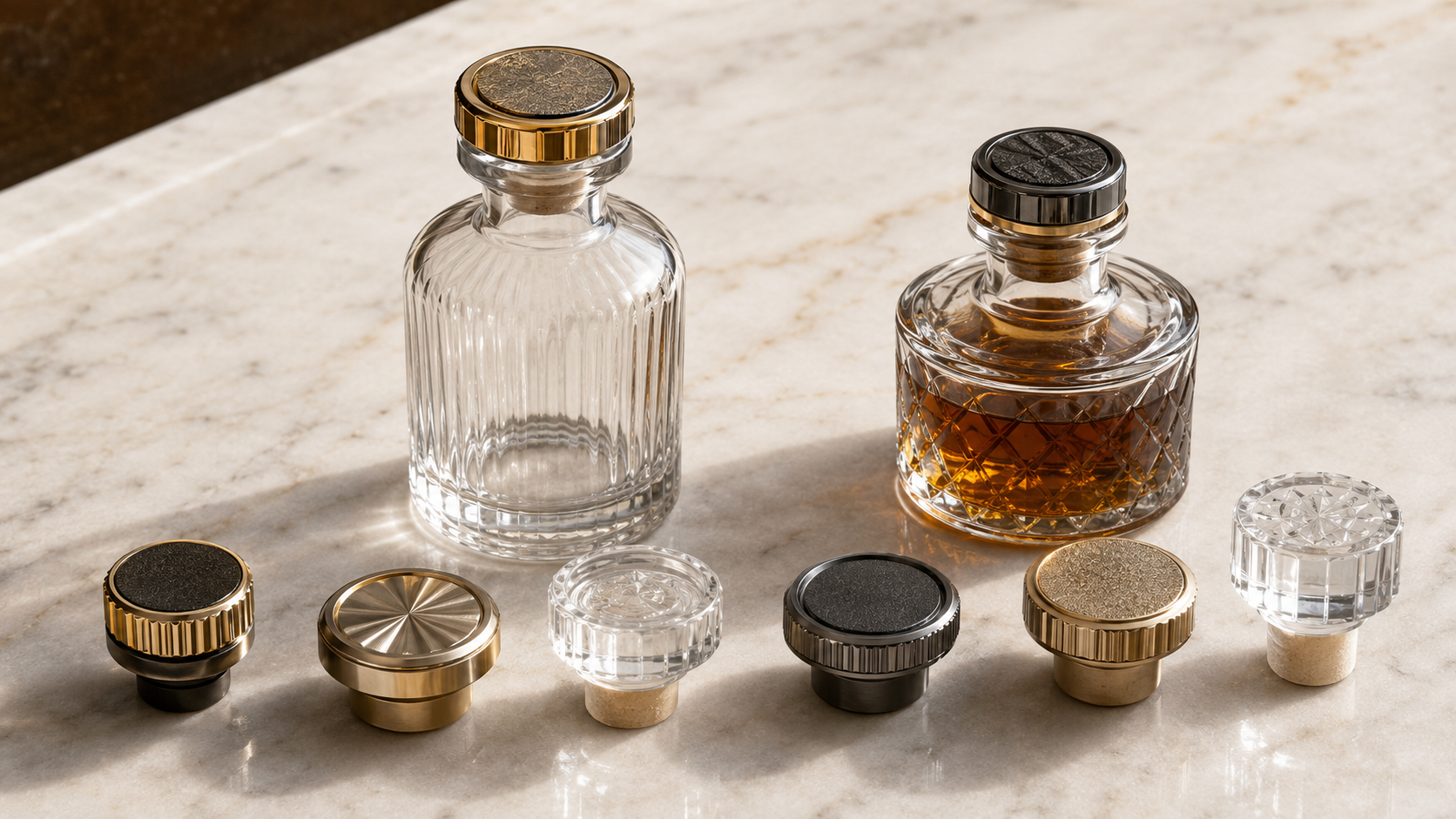
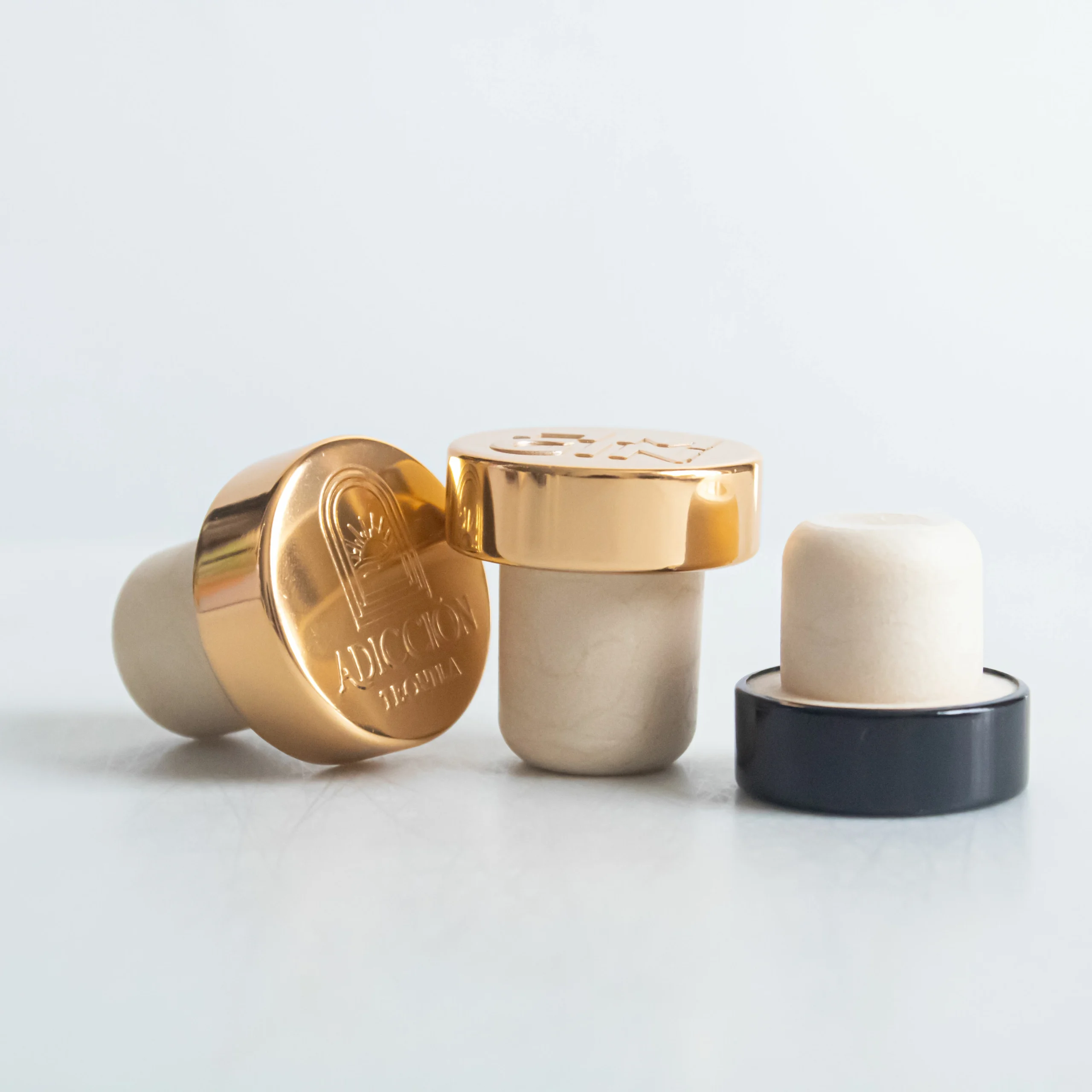
Metal and zamac stoppers are suitable for luxury rum, collector bottles, and premium travel retail packaging. Their heavier hand feel can make the bottle feel more valuable before the customer even tastes the product.
Common finish options include brushed gold, antique copper, matte black, polished silver, gunmetal, bronze, and custom electroplated colors. Custom metal stoppers for premium spirits can also support embossed logos, engraved details, custom medallions, sidewall texture, and limited-edition design elements.
Zamac is useful when a brand needs sculptural detail. It can be molded into custom shapes and combined with synthetic cork or natural cork shanks. This makes it suitable for high-end rum brands that want the closure to become part of the collectible identity of the bottle.
Glass and Crystal-Style Stoppers for Decorative Rum Bottles
Glass and crystal-style stoppers are often used for special-edition spirits, decanters, and display bottles. They provide a refined appearance and strong gift-pack value.
These closures require careful fit testing and protective packing. Glass, crystal-style, and decorative closures are more sensitive to impact during transport, so export packaging should be planned early in the project.
ROPP Caps, Screw Caps, and Non-Refillable Closures for Rum
ROPP caps, screw caps, and non-refillable closures are suitable for rum brands that need efficient filling, tamper evidence, export security, or anti-counterfeit protection.
Not every rum bottle needs a decorative stopper. Many brands need closure systems that support speed, security, and cost control.
ROPP caps are aluminum closures formed onto the bottle neck during capping. They are commonly used where tamper evidence, sealing reliability, and high-speed production are important. For export rum, custom ROPP closures for spirits bottles can be a practical choice when the bottle thread profile and capping equipment are compatible.
Screw caps are suitable for flavored rum, mini bottles, white rum, cocktail-focused products, and high-volume lines. They are easy to open, resealable, and efficient for production. The liner inside the cap should be selected according to alcohol content, storage conditions, and target market requirements.
Non-refillable closures are used when anti-counterfeit protection and controlled pouring are important. Non-refillable closures for spirits bottles can help reduce refilling risk and improve product security in export markets, duty-free channels, and regions where counterfeit spirits are a concern.
For functional closure systems, buyers should consider:
- Bottle thread profile
- Cap diameter
- Liner material
- Application torque
- Removal torque
- Tamper-evident band performance
- Pouring behavior
- Alcohol compatibility
- Filling-line speed
- Carton and pallet transport conditions
When comparing custom bottle closures for rum, brands should evaluate both appearance and performance. A premium closure must look good, but it also needs to seal reliably and perform consistently in production.
Matching Rum Bottle Closures to Neck Finish and Filling Line
To match a rum bottle closure correctly, buyers should confirm the bottle neck inner diameter, closure shank diameter, thread profile, filling-line method, torque requirement, leakage test standard, and destination market.
A good closure project starts with the bottle. Even the most attractive stopper can fail if the neck finish, inner diameter, or capping process is not suitable.
Before requesting samples, prepare the following information:
- Bottle drawing or physical bottle sample
- Neck inner diameter
- Neck outer diameter
- Neck finish type
- Bottle capacity
- Closure type preference
- Head material preference
- Shank material preference
- Logo artwork
- Color and finish requirements
- Estimated order quantity
- Filling-line method
- Alcohol strength
- Destination market
- Required compliance documents
- Target launch date
For bar-top corks and T-top stoppers, the neck inner diameter and shank diameter are critical. For ROPP caps, the bottle thread and capping head must match. For screw caps, torque, liner selection, and thread engagement need careful control. For non-refillable closures, the buyer should also test pouring behavior, tamper evidence, and consumer opening experience.
For U.S. market planning, buyers should also review TTB distilled spirits labeling guidance because label content, class/type designation, alcohol content, and brand presentation must be considered together with the final packaging system.
Technical Specifications Buyers Should Confirm
Custom rum bottle closures should be evaluated with clear technical standards, including shank diameter, pull-out force, leakage resistance, torque, liner compatibility, alcohol resistance, and surface finish consistency.
| Specification | Why It Matters |
|---|---|
| Neck inner diameter | Determines shank fit and sealing pressure |
| Shank diameter | Affects insertion force, pull-out force, and leakage resistance |
| Shank length | Influences sealing depth and closure stability |
| Head diameter | Affects appearance and handling |
| Pull-out force | Determines consumer opening experience and resealing confidence |
| Application torque | Important for screw caps and ROPP caps |
| Removal torque | Affects ease of opening and consumer satisfaction |
| Liner compatibility | Helps protect against leakage and alcohol interaction |
| Surface finish standard | Controls visual consistency for premium packaging |
| Logo position tolerance | Keeps branding consistent across batches |
| Alcohol resistance | Confirms material suitability for spirits packaging |
| Leakage testing | Reduces transport and storage risk |
| Drop-test packing | Helps protect closures during export shipping |
For materials that contact beverages, buyers should confirm whether closure components, liners, coatings, plastics, corks, adhesives, and inserts meet relevant food-contact requirements. The FDA explains that a food contact substance can include packaging and its components, including substances applied to packaging surfaces such as adhesives or colorants, which makes food packaging and food-contact substance review important when closures are used for beverage applications.
For premium rum packaging, consistent appearance is also essential. Buyers should define acceptable standards for wood grain, plating color, logo depth, surface scratches, assembly alignment, and packaging protection.
Customization Options for Rum Bottle Closures
Custom rum bottle closures can be customized through logo engraving, embossing, debossing, laser marking, hot stamping, color matching, plating, custom molds, and decorative capsule matching.
Common customization options include:
- Logo engraving
- Embossing
- Debossing
- Laser marking
- Hot foil stamping
- Screen printing
- Pad printing
- Color matching
- Matte finish
- Glossy finish
- Metallic plating
- Antique finish
- Wood staining
- Custom top shape
- Custom mold development
- Sidewall texture
- Medallion insert
- Capsule color matching
- Tamper-evident band design
For premium rum, the closure should be designed together with the label, bottle, capsule, carton, and brand story. A Caribbean-style aged rum may use a dark wooden top with gold foil branding. A modern spiced rum may choose a matte black metal stopper with an embossed icon. A luxury reserve rum may use a zamac stopper with a custom medallion and decorative capsule.
Decoration should be planned as part of the full packaging system. Brands that need specialist logo treatment, finish concepts, color systems, or packaging decoration support can coordinate closure artwork with Kandacork Decoration & Branding so the closure, label, bottle, and secondary packaging feel consistent.
For large-volume production, customization should also consider repeatability. Color, logo depth, surface finish, closure assembly, and packaging quality should remain consistent from batch to batch.
Quality Control, Sealing Tests, and Compliance
Quality control for custom rum bottle closures should include dimensional inspection, leakage testing, pull-out force testing, torque testing, alcohol resistance evaluation, appearance inspection, and batch traceability.
A rum closure is a functional packaging component. It should be tested for safety, fit, appearance, and production reliability.
Quality control may include:
- Raw material inspection
- Dimensional measurement
- Shank diameter control
- Head diameter control
- Surface finish inspection
- Logo accuracy check
- Color consistency check
- Pull-out force testing
- Leakage testing
- Alcohol resistance evaluation
- Assembly strength testing
- Torque testing for caps
- Tamper-evident band inspection
- Packaging drop protection
- Batch traceability
For export projects, closure packaging should also be considered. Transport cartons may be exposed to vibration, compression, stacking, and impact. The ISO method for vertical impact testing of complete filled transport packages is a useful reference point when buyers evaluate whether packaging can withstand distribution hazards.
The goal is not only to pass inspection but to build a repeatable closure system that performs consistently during filling, shipping, retail display, and consumer use.
Bottle, Closure, and Full Packaging Coordination
A custom closure performs best when it is developed together with the bottle. Neck geometry, glass tolerance, thread profile, filling method, label position, capsule height, carton fit, and brand decoration all affect the final result.
For brands still developing the full rum bottle package, Kandacork Glass can support bottle-focused projects, while closure development can be coordinated around the neck finish and desired opening experience. This is especially useful for premium rum bottles, gift sets, and private-label projects where the bottle silhouette and closure must feel like one design.
For broader spirits programs, Kandacork Spirits Bottle provides category-focused support for glass spirits bottle concepts, helping brands align bottle shape, closure direction, decoration, and commercial positioning before bulk production.
Sustainability may also be part of the specification. Glass packaging has strong recyclability advantages, and the Glass Packaging Institute notes that glass can be recycled repeatedly without loss in quality or purity. For rum brands, this can support packaging stories around recyclability, refill awareness, and responsible material selection when the closure, bottle, and secondary packaging are designed together.
MOQ, Sampling, Lead Time, and Bulk Production
A custom rum bottle closure project usually moves from concept review to drawing confirmation, sample development, fit testing, bulk production approval, and export packing.
Concept and Closure Selection
The buyer shares the bottle type, rum category, brand positioning, retail price level, target market, and commercial goal. A premium aged rum may need a heavier closure with stronger shelf impact. A white rum for high-volume distribution may need a practical screw cap or ROPP cap. A limited-edition rum may need a custom mold, metal finish, or decorative medallion.
Drawing and Material Confirmation
The closure structure, head material, shank material, dimensions, color, logo position, and surface finish are confirmed. At this stage, technical details such as shank diameter, head diameter, insertion depth, liner type, and capping method should be reviewed.
Sample Development and Testing
Samples are produced for visual approval, bottle fit testing, leakage testing, and filling-line trials. This stage is especially important because bottle tolerance and closure material behavior can affect the final result.
Bulk Production Approval
After sample approval, production specifications are locked. These may include dimensions, material grade, logo process, color standard, finish, packaging method, inspection criteria, and shipping requirements.
Export Packing and Delivery
Custom rum closures should be packed to protect surface finish and prevent deformation during transport. Metal, zamac, wood, and glass stoppers require stronger protective packing, especially for export shipments and long-distance logistics.
For brands that need bottle and closure coordination in one purchasing program, Kandacork Glass Packaging can help align glass packaging direction with closure requirements, carton planning, and export shipment needs.
Why Work with Kandacork Closures
Kandacork Closures helps rum brands develop custom bottle closures that match the bottle neck, brand identity, sealing requirements, decoration method, production volume, and export packaging needs.
Support can include:
- Custom wooden stoppers
- Metal and zamac stoppers
- Synthetic cork shanks
- Natural cork shanks
- Bar-top corks and T-top closures
- ROPP caps
- Screw caps
- Non-refillable closures
- Capsules and decorative finishing
- Logo engraving and embossing
- Hot stamping and laser marking
- Custom color and plating options
- Sample development
- Bottle-neck fit evaluation
- Bulk production for spirits brands
- OEM and private-label packaging projects
- Export packing for international buyers
For rum brands, this means the closure can be developed around the bottle, the brand identity, and the production requirements. Whether you need a classic wooden stopper for aged rum, a metal closure for premium rum, or a secure ROPP cap for export rum, Kandacork Closures can help build a closure system that supports product protection and brand value.
Glossary of Rum Bottle Closure Terms
Bar-top cork: A spirits closure with a decorative top and a cork or synthetic shank that fits into the bottle neck.
T-top stopper: Another name for a bar-top closure, commonly used for premium spirits bottles.
ROPP cap: A roll-on pilfer-proof aluminum cap used for secure sealing and tamper-evident packaging.
Non-refillable closure: A closure system designed to reduce refilling, tampering, and counterfeit risk.
Pull-out force: The force required to remove a stopper from the bottle neck.
Application torque: The force applied when closing a screw cap or similar closure during capping.
Removal torque: The force required for the consumer to open a screw cap or closure.
Bottle neck finish: The shape and dimensions of the bottle opening, thread, sealing surface, and closure contact area.
Synthetic cork shank: A man-made stopper shank designed for consistent dimensions and stable sealing performance.
Tamper-evident band: A closure feature that shows visible evidence when a bottle has been opened.
FAQ
What is the best closure for premium rum bottles?
The best closure for premium rum is usually a bar-top cork, wooden stopper, metal stopper, or zamac stopper. These closures improve shelf appeal, resealability, hand feel, and perceived value. The final choice should be confirmed based on bottle neck finish, filling-line method, target price, and brand positioning.
Are bar-top corks suitable for aged rum?
Yes. Bar-top corks are suitable for aged rum and other premium spirits. They provide a traditional appearance, reusable sealing, and a premium opening experience. The shank size, material, and pull-out force should be tested with the actual bottle before mass production.
Can rum bottle closures be customized with a logo?
Yes. Rum bottle closures can be customized with engraving, embossing, debossing, laser marking, hot stamping, screen printing, color matching, plating, and custom mold development. The best decoration method depends on the closure material and the brand design.
What information is needed to quote custom bottle closures for rum?
Suppliers usually need the bottle drawing, neck finish, closure type, material preference, logo artwork, estimated order quantity, destination market, and target launch date. A physical bottle sample is also useful for accurate fit testing.
Are ROPP caps suitable for rum bottles?
Yes. ROPP caps can be suitable for rum bottles, especially for export lines, high-speed filling, and products requiring tamper evidence. The bottle thread profile and capping equipment must be compatible.
Can Kandacork Closures supply non-refillable closures for rum?
Yes. Non-refillable closures can be developed for rum brands that need anti-counterfeit protection, tamper evidence, or controlled pour behavior. They are often used for premium spirits, duty-free products, and export markets.
What is the MOQ for custom rum bottle closures?
MOQ depends on closure type, material, decoration method, mold requirements, and production process. Standard closure structures may have lower MOQ, while custom molds, zamac stoppers, metal parts, and complex non-refillable closures usually require higher order quantities.
Can I request samples before bulk production?
Yes. Sampling is strongly recommended. Samples help confirm appearance, neck fit, insertion force, pull-out force, leakage resistance, torque performance, and filling-line compatibility before bulk production.
How do I choose the right shank size for a rum bottle stopper?
The right shank size depends on the bottle neck inner diameter, closure material, insertion depth, and required pull-out force. The shank is usually designed to create controlled compression inside the bottle neck, but final sizing should be confirmed through sample testing.
Which closure is better for export rum?
ROPP caps and non-refillable closures are often strong choices for export rum because they support tamper evidence, secure sealing, and brand protection. Premium export rum may also use a bar-top cork or metal stopper with additional tamper-evident packaging.
Request Custom Bottle Closures for Your Rum Brand
If you are developing custom bottle closures for rum, send Kandacork Closures your bottle drawing, closure concept, logo artwork, estimated order quantity, and destination market. The team can help you compare bar-top corks, wooden stoppers, metal stoppers, ROPP caps, screw caps, and non-refillable closures based on your bottle design and production requirements.
A well-designed rum closure does more than seal the bottle. It protects the spirit, strengthens brand identity, supports export logistics, and creates a better consumer experience from the first opening to the final reseal.