Introduction
Bar-top stoppers for mini spirits bottles are used when a small-format spirits bottle needs stronger shelf appeal, better opening feel, and more brand value than a basic screw cap. For spirits brands, distilleries, private label buyers, importers, distributors, bottlers, and packaging buyers, the closure is not only a decorative component. It affects sealing performance, filling-line efficiency, export packing, consumer experience, and total packaging cost.
Mini spirits bottles are commonly used for 50 ml liquor samples, 100 ml tasting bottles, 187 ml travel retail formats, 200 ml gift packs, hotel minibars, promotional launches, private label tasting sets, and limited-edition collections. Because these bottles are small, closure fit must be reviewed carefully. A stopper that works well on a full-size spirits bottle may be too large, too heavy, or technically unsuitable for a miniature bottle.
This guide explains how to choose bar-top stoppers for mini spirits bottles, compare closure types, avoid common fit problems, evaluate supplier capability, and prepare a practical sample or quotation request with Kandacork Closures.
Buyer Quick Summary
| Buyer Question | Short Answer |
|---|---|
| Best use case | Premium mini spirits, tasting kits, gift sets, craft samples, and private label launches |
| Best bottle sizes | 50 ml, 100 ml, 187 ml, and 200 ml mini spirits bottles |
| Best materials | Plastic, aluminum, wood, synthetic, and lightweight metal-look options |
| Key technical check | Corkmouth bore, shank diameter, insertion depth, leakage test, and packing fit |
| When not to use | Lowest-cost, very high-speed, or strict tamper-evident projects |
| Next step | Send bottle drawing, neck dimensions, logo file, target quantity, and packing method |
Quick Answer: Are Bar-Top Stoppers Suitable for Mini Spirits Bottles?
Yes. Bar-top stoppers can be suitable for mini spirits bottles if the shank diameter, corkmouth bore, insertion depth, neck tolerance, leakage performance, and filling method are confirmed through sample testing.
They are most useful for premium 50 ml and 100 ml spirits bottles, craft distillery sampler packs, private label tasting sets, travel retail gift packs, hotel minibar bottles, and limited-edition promotional bottles. They are less suitable when the project requires the lowest unit cost, very high-speed automated capping, or strong built-in tamper-evident performance.
For B2B buyers, the better question is not simply “Should we use a bar-top stopper?” The better question is: does this closure match the bottle size, brand position, production method, target market, and required test performance?
What Are Bar-Top Stoppers for Mini Spirits Bottles?
Bar-top stoppers, also called T-top stoppers, T-corks, bartop corks, or liquor bottle stoppers, are closures with two functional parts.
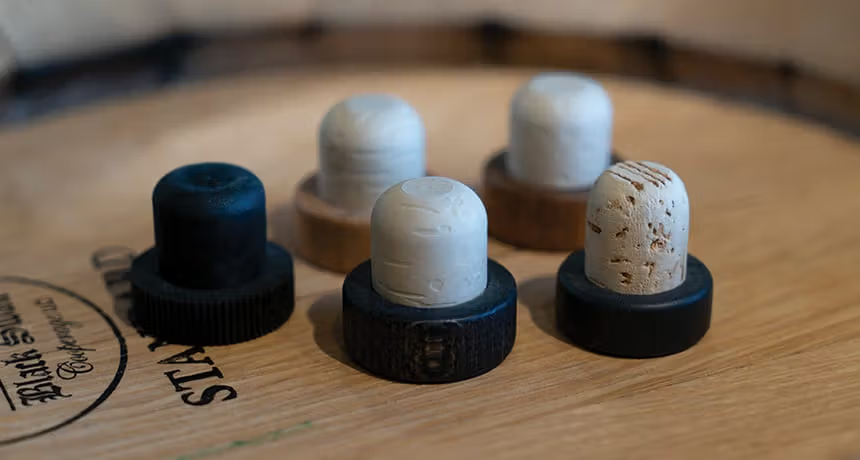
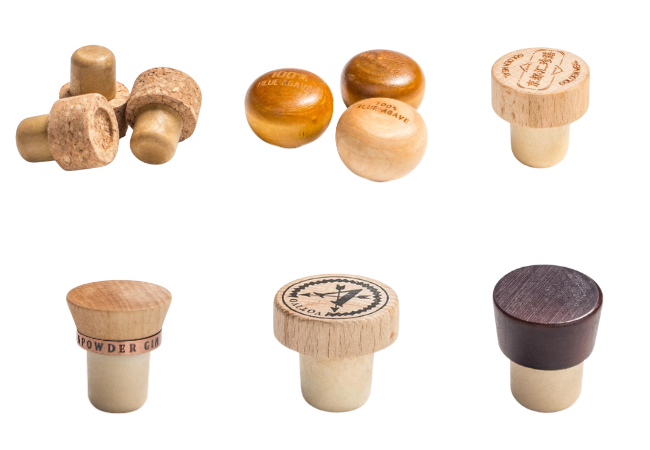
The top is the visible part. It provides grip, brand appearance, color, shape, texture, and decoration. It may be made from plastic, wood, aluminum, zinc alloy, ceramic, glass, or other customized materials.
The shank is the sealing part. It fits inside the bottle neck and creates compression against the inner wall. It may be made from natural cork, agglomerated cork, synthetic cork, TPE, or polymer materials.
For projects that require standard or customized T-top closure structures, Kandacork Closures offers custom bar-top stoppers with material, branding, bottle-neck review, sample testing, and bulk supply support.
For mini spirits bottles, proportion is critical. The closure must look balanced on the bottle, fit the neck correctly, and work with cartons, gift boxes, trays, shrink bands, labels, and filling-line equipment.
Bar-Top Stopper Anatomy for Mini Spirits Bottles
A mini bottle bar-top stopper includes a visible top head and an inserted sealing shank. Buyers should check the top diameter, shank diameter, corkmouth bore, insertion depth, and bottle neck inner diameter before sample approval.
Image caption: Anatomy of a mini spirits bottle bar-top stopper, showing the top head, sealing shank, bottle neck inner diameter, corkmouth bore, insertion depth, and top diameter.
Image alt text: Bar-top stopper anatomy for mini spirits bottles showing top head, shank, corkmouth bore, insertion depth, and bottle neck inner diameter.
Mini Bottle Sizes and Stopper Requirements
Different mini bottle sizes require different closure decisions. A 50 ml bottle usually needs a compact, lightweight, cost-controlled closure. A 100 ml spirits bottle provides more branding space but still needs careful neck-fit testing. A 187 ml or 200 ml bottle can often support a more premium bar-top stopper with stronger visual impact.
| Bottle Size | Common Use | Main Closure Concern | Recommended Direction |
|---|---|---|---|
| 50 ml | Sampling, minibar, promotions | Small bore, limited branding space, cost sensitivity | Compact plastic, aluminum, or synthetic bar-top stopper |
| 100 ml | Tasting kits, private label spirits | Better branding space, still tight tolerance | Custom plastic, wood, aluminum, or synthetic stopper |
| 187 ml | Travel retail, premium trial size | Higher value perception and export packing | Aluminum, wood, or premium synthetic stopper |
| 200 ml | Gift packs, tasting bottles, retail sets | More room for premium design | Wood, aluminum, metal-look, or custom bar-top stopper |
The smaller the bottle, the more important stopper weight, top diameter, shank fit, and packing compatibility become. A heavy or oversized stopper can make a mini bottle unstable, increase carton space, or create poor visual balance.
Bar-Top Stoppers vs Screw Caps vs ROPP Closures
Bar-top stoppers for mini spirits bottles are not always the best closure option. Buyers should compare closure types based on product positioning, filling method, tamper-evident needs, and cost target.
| Closure Type | Best Use Case | Advantages | Limitations |
|---|---|---|---|
| Bar-top stopper | Premium mini spirits, tasting kits, gift sets | Strong brand appeal, reusable feel, custom material options | Requires fit testing and may cost more |
| Plastic screw cap | Low-cost mini bottles and promotions | Lightweight, economical, easy to apply | Less premium appearance |
| Aluminum screw cap | Modern retail mini bottles | Clean look, printable surface, efficient capping | Less tactile value than custom stoppers |
| ROPP closure | High-volume bottling | Good line efficiency and tamper-evident performance | Requires compatible neck finish and capping equipment |
| Tamper-evident cap | Retail and regulated markets | Clear opening control | May reduce craft or premium appearance |
| Non-refillable closure | Controlled dispensing or anti-refill needs | Adds product security | More complex and usually higher cost |
If the product is a basic airline-size bottle or mass promotional giveaway, a screw cap may be more practical. If the project is a premium sampler, private label gift pack, craft spirits tasting set, or collectible miniature, a bar-top stopper can deliver stronger commercial value.
How to Decide: Bar-Top Stopper or Screw Cap?
Choose a bar-top stopper if the mini bottle is designed for premium gifting, craft spirits, tasting kits, private label presentation, hotel minibar upgrades, or limited-edition branding.
Choose a screw cap if the project is highly cost-sensitive, uses very small mass-market bottles, or needs simple high-speed application.
Choose a ROPP closure if the bottle neck and filling line are designed for high-volume capping and stronger tamper-evident control.
Choose a tamper-evident or non-refillable closure if the destination market, retailer, or importer requires stronger opening control, dispensing control, or anti-refill protection.
This decision flow helps buyers avoid over-specifying the closure. A premium custom bar-top stopper can add strong brand value, but it should be used where the bottle format, target price, and packaging experience justify it. For teams still comparing closure directions, Kandacork Closures can support early-stage bar-top stopper development from structure review to sample confirmation.
50 ml Liquor Bottle Stoppers: What Buyers Should Check
50 ml liquor bottle stoppers require tighter review because the bottle is small, the neck area is limited, and the closure can easily look oversized.
Buyers should check the inner neck diameter, corkmouth bore, shank diameter, top diameter, top height, and total stopper weight. For 50 ml mini liquor bottles, lightweight plastic, compact aluminum, or synthetic bar-top stoppers are often more practical than heavy metal tops.
Branding should also be simplified. A small logo, clean color, or single top decoration usually works better than complex artwork on a very small closure surface.
100 ml Spirits Bottle Closures for Tasting Kits and Private Label
100 ml spirits bottle closures allow more room for branding than 50 ml bottles, making them suitable for private label tasting kits, craft sampler packs, and premium trial-size spirits.
For 100 ml bottles, custom bar-top stoppers can support stronger shelf appeal without becoming too large if the top diameter and shank length are controlled. Wood, aluminum, plastic, and synthetic options can all work depending on the target price and brand image.
Buyers should test the stopper inside the final gift box, tasting tray, or carton. A closure that looks good on the bottle may still fail if it makes the pack too tall or too tight.
How to Read Stopper Dimensions
Many closure problems come from misunderstanding stopper size. Bar-top closures are often described by top diameter and shank diameter. The top controls the appearance and grip. The shank controls the actual bottle fit.
Before ordering mini spirits bottle stoppers, buyers should confirm:
- Bottle capacity
- Neck finish
- Inner neck diameter
- Corkmouth bore
- Shank diameter
- Shank length
- Insertion depth
- Top diameter
- Total closure weight
- Tolerance range
- Filling and packing method
A shank that is too small may feel loose or cause leakage. A shank that is too large may be hard to insert, create excessive pull-out force, or stress the glass neck. A top that is too wide may interfere with gift boxes, carton dividers, shrink bands, or display packaging.
Final approval should be based on filled-bottle testing, including insertion force, pull-out force, leakage, reclosure, and transport packing. For a deeper technical reference on stopper sizing, buyers can review the Kandacork Closures bar-top stopper size guide.
Top Material vs Shank Material: What Buyers Should Separate
The top and the shank should be evaluated separately. The top is mainly about branding, handling, and visual value. The shank is mainly about sealing, compression, alcohol-contact suitability, and reclosure performance.
| Component | Main Function | Common Options | Buyer Focus |
|---|---|---|---|
| Top | Branding, grip, shelf appeal | Plastic, wood, aluminum, metal, glass, ceramic | Appearance, weight, logo, cost, proportion |
| Shank | Sealing and reclosure | Natural cork, agglomerated cork, synthetic cork, TPE, polymer | Fit, compression, pull-out force, alcohol contact |
| Material | Best For | Buyer Note |
|---|---|---|
| Plastic | 50 ml samples, promotions, private label programs | Lightweight, economical, easy to color match |
| Wood | Craft spirits, whisky, rum, tasting kits | Premium natural look, but color variation should be reviewed |
| Aluminum | Gin, vodka, tequila, modern mini bottles | Premium appearance with lower weight |
| Synthetic | Repeat orders and larger production runs | Good dimensional consistency |
| Metal or zinc alloy | Luxury limited editions and collectible sets | Premium feel, but may be too heavy for small bottles |
For mini spirits bottles, the best material is not always the most expensive one. The best choice is the material that fits the bottle, supports the brand story, works in production, and meets the target cost. When the sealing component is the main concern, comparing cork, synthetic cork, TPE, and polymer options through a cork shank vs synthetic shank buyer guide can help buyers separate visual design from sealing performance.
Common Problems When Using Bar-Top Stoppers on Mini Bottles
Mini bottle closure failures are usually caused by poor fit, incorrect material selection, or insufficient sample testing.
| Problem | Likely Cause | How to Avoid It |
|---|---|---|
| Stopper feels loose | Shank too small or neck bore too large | Test multiple shank sizes with actual bottles |
| Leakage during shipping | Poor compression or unstable fit | Conduct filled-bottle leakage and vibration testing |
| Stopper hard to insert | Shank too large or material too stiff | Adjust shank size, material, or insertion depth |
| Difficult pull-out | Excessive compression | Test pull-out force before production |
| Top looks oversized | Top diameter not scaled to bottle size | Review bottle proportion and final packaging |
| Bottle becomes top-heavy | Closure material too heavy | Use lightweight plastic, aluminum, or synthetic options |
| Gift box does not close | Stopper too tall or too wide | Test closures inside final trays, cartons, or gift boxes |
| Decoration looks unclear | Logo too complex for small surface | Simplify logo or adjust decoration method |
| Bulk order differs from sample | Poor tolerance control | Confirm pre-production samples before mass production |
This is why bar-top stoppers for mini spirits bottles should never be approved only from photos or nominal dimensions. Physical sample testing is essential.
Testing Checklist Before Bulk Production
Before confirming a bulk order, buyers should test both appearance and performance.
| Test Item | What to Check |
|---|---|
| Visual proportion test | Does the stopper look balanced on the bottle? |
| Neck fit test | Does the shank fit smoothly into the neck? |
| Insertion force test | Can workers or machines apply the stopper consistently? |
| Pull-out force test | Is the stopper secure but easy to remove? |
| Leakage test | Does the filled bottle leak under normal handling? |
| Reclosure test | Does the stopper still seal after repeated opening? |
| Alcohol-contact review | Is the shank material suitable for the product? |
| Temperature check | Does performance change under warm or cold conditions? |
| Vibration test | Does the stopper loosen during transport simulation? |
| Packing test | Does the bottle fit cartons, trays, sleeves, or gift boxes? |
| Decoration review | Are logo, color, finish, and surface quality acceptable? |
| Pre-production approval | Does the production sample match the approved sample? |
For 50 ml and 100 ml bottles, leakage testing is especially important because small neck tolerances leave less room for error.
Before confirming bulk production, buyers can send bottle drawings, neck dimensions, target material, logo files, packing method, and estimated order quantity to Kandacork Closures for sample development and fit review.
Branding and Decoration Options
Mini spirits bottles have limited label space, so the stopper can become a major branding surface. Common customization options include top printing, embossing, debossing, hot stamping, laser marking, molded logos, Pantone color matching, metallic finishing, matte or gloss surfaces, wood staining, decorative inserts, and custom top shapes.
For small stoppers, simple branding usually works better than complex artwork. A clear logo, recognizable color, and balanced material choice often create a stronger impression than a crowded design.
Kandacork Closures can help buyers review decoration methods based on the stopper material, top diameter, logo size, order quantity, and final packaging style. If the project also requires bottle decoration, cartons, labels, or a coordinated retail presentation, Kandacork’s wider integrated spirits packaging support can help buyers align bottles, closures, decoration, and export packing as one system.
Filling-Line, Packing, and Tamper-Evident Checks
Buyers should confirm how the stopper will be applied before approving the closure. Manual insertion may work for craft distillery samplers, limited-edition gift sets, and small private label batches. Semi-automatic insertion may suit medium production runs. Automated lines usually require tighter dimensional consistency and compatibility with feeding and insertion equipment.
Packing should be tested early. Mini bottles may be placed in cartons, hotel minibar packs, tasting trays, promotional kits, travel retail sets, or gift boxes. The stopper should not loosen, damage neighboring bottles, or make the final pack too bulky.
Tamper evidence should also be reviewed before closure approval. Some projects may use shrink capsules, neck bands, seals, or secondary packaging. Others may require screw caps or ROPP closures instead of bar-top stoppers.
Compliance and Market Considerations
Spirits packaging should be reviewed according to the destination market. For the U.S. market, the Alcohol and Tobacco Tax and Trade Bureau is an important authority for distilled spirits standards of fill and net contents labeling. Buyers should confirm whether the selected bottle volume is suitable for the intended market and whether the label presents net contents correctly according to TTB distilled spirits net contents guidance.
For food-contact safety, closure and shank materials should be reviewed according to applicable requirements. In the United States, the FDA explains that food-contact substances include packaging components that come into contact with food or beverages, so buyers should confirm material suitability for the intended liquid and market through relevant FDA food-contact substance guidance.
For export projects, buyers should ask suppliers about material declarations, product consistency, documentation support, and protective packing.
Supplier Evaluation Checklist
A reliable supplier should do more than provide a catalog stopper. Mini spirits bottle closures require technical support, material advice, sample development, and production consistency.
| Supplier Capability | Why It Matters |
|---|---|
| Bottle-neck review | Reduces mismatch and leakage risk |
| Material recommendation | Helps balance appearance, cost, and performance |
| Shank fit support | Improves sealing and pull-out feel |
| Custom top development | Supports brand differentiation |
| Logo decoration support | Improves commercial presentation |
| Sample production | Allows testing before bulk order |
| Pre-production approval | Reduces production variation |
| Bulk consistency control | Supports repeat orders |
| MOQ discussion | Helps match launch scale and budget |
| Export packing support | Protects closures during international shipping |
| Lead-time planning | Supports launch schedules |
| Multi-component coordination | Aligns closure, bottle, label, capsule, and gift box |
For commercial buyers, supplier capability is often as important as the closure itself. A technically suitable stopper reduces leakage risk, improves production reliability, and helps the finished bottle look consistent in market.
Mini Spirits Bottle Stopper RFQ Checklist
Before requesting samples or a quotation, prepare the key details that affect stopper recommendation, sample lead time, tooling cost, and unit price.
| RFQ Detail | Why It Helps |
|---|---|
| Bottle drawing | Confirms neck finish, bore, and dimensional limits |
| Physical bottle sample | Allows real fit and leakage testing |
| Bottle capacity | Helps select stopper proportion and cost level |
| Neck inner diameter | Supports shank size recommendation |
| Corkmouth bore | Helps confirm stopper compression |
| Desired top material | Defines visual style and budget range |
| Preferred shank material | Supports sealing and reclosure performance |
| Logo file | Allows decoration review |
| Pantone or finish reference | Supports color and surface matching |
| Target quantity | Affects MOQ, tooling, and unit cost |
| Destination market | Helps review compliance and packing needs |
| Filling method | Confirms manual, semi-automatic, or automatic suitability |
| Packing method | Ensures stopper works with cartons, trays, or gift boxes |
| Required timeline | Supports sample and bulk production planning |
If technical drawings are not available, the project can start with bottle photos, target capacity, and packaging goals. However, final approval should be based on accurate dimensions or physical bottle samples.
Example: Choosing a Stopper for a 100 ml Private Label Spirits Bottle
For a 100 ml private label tasting bottle, a buyer may choose a lightweight aluminum bar-top stopper with a synthetic shank. The aluminum top improves shelf appeal and gives the bottle a more refined appearance, while the synthetic shank supports consistent fit across repeat orders.
Before approval, the buyer should test neck fit, insertion force, pull-out force, leakage, gift-box height, and logo clarity. If the stopper makes the bottle too tall for the gift box, the top height or material should be adjusted before bulk production.
This type of sample review helps avoid a common problem in mini bottle packaging: the closure looks good alone but fails when tested with the final bottle, label, tray, carton, or gift set.
How Kandacork Closures Supports Mini Spirits Bottle Projects
Kandacork Closures supports custom closure development for spirits packaging projects where appearance, technical fit, and supply reliability all matter.
For mini spirits bottle stoppers, Kandacork Closures can help buyers compare closure materials, review bottle-neck compatibility, select shank options, develop custom top shapes, prepare branded samples, confirm decoration methods, and plan bulk production.
Support areas include:
- Custom bar-top stopper development
- Plastic, wood, aluminum, synthetic, and metal-look options
- Shank selection and fit review
- Logo and finish customization
- Color matching
- Sample production
- Pre-production confirmation
- Bulk order planning
- Export packing support
- Coordination with bottles, labels, capsules, and gift boxes
This support is valuable for spirits brands, distilleries, private label buyers, importers, distributors, bottlers, and packaging buyers developing new mini bottle lines, tasting sets, promotional spirits, travel retail packs, or premium sample programs.
Conclusion
Bar-top stoppers for mini spirits bottles can make small-format spirits packaging feel more premium, memorable, and brand-specific. They are especially useful for tasting kits, gift sets, craft distillery samplers, private label collections, hotel minibar bottles, travel retail packaging, and limited-edition miniatures.
However, the closure must be selected carefully. Buyers should evaluate bottle size, neck bore, shank diameter, stopper material, closure weight, filling method, tamper-evident needs, packing format, and destination-market requirements.
The safest path is to test real samples before bulk production. A well-matched stopper can improve appearance, support reclosure, reduce leakage risk, and create a better consumer experience.
To request sample development or a quotation from Kandacork Closures, prepare your bottle drawing, neck dimensions, bottle capacity, desired material, logo file, target order quantity, destination market, and expected production timeline, then send your closure project brief for review.
FAQ
Are bar-top stoppers suitable for 50 ml spirits bottles?
Yes. Bar-top stoppers can be suitable for 50 ml spirits bottles if the shank diameter, corkmouth bore, insertion depth, and leakage performance are confirmed through sample testing. Lightweight plastic, aluminum, or synthetic options are often practical for small formats.
What should buyers check for 50 ml liquor bottle stoppers?
Buyers should check the bottle neck inner diameter, corkmouth bore, shank diameter, insertion depth, top diameter, stopper weight, leakage performance, and final packing method. For 50 ml bottles, compact and lightweight closures are usually safer than heavy oversized tops.
Are screw caps better than bar-top stoppers for mini liquor bottles?
Screw caps may be better for high-volume, low-cost, or tamper-evident mini liquor bottles. Bar-top stoppers are better when premium appearance, brand differentiation, and reusable opening feel are more important.
What is the best material for mini spirits bottle stoppers?
Plastic and synthetic materials are often practical because they are lightweight, repeatable, and cost-controlled. Wood, aluminum, and metal-look tops are suitable for premium gift sets, craft spirits, and limited-edition mini bottles.
Do mini spirits bottle stoppers need leakage testing?
Yes. Leakage testing is recommended because mini bottle necks have limited tolerance margins. Testing should include filled samples, repeated opening, transport handling, and packing checks.