Screw cap leakage prevention starts with one practical rule: the cap, liner, bottle neck finish, torque setting, product formula, filling process, and shipping environment must work as one closure system. A leak-free bottle is not created by tightening the cap harder. It is created by selecting the right components, applying them correctly, and testing the filled package before bulk production.
For beverage, spirits, oil, syrup, cosmetic, and specialty liquid brands, screw cap leakage can cause product loss, stained labels, damaged cartons, customer complaints, rejected shipments, and poor shelf presentation. In export and e-commerce channels, one leaking bottle can damage an entire case and weaken buyer confidence.
Kandacork Closures helps brands reduce leakage risk by supporting cap-to-bottle matching, liner selection, torque review, decoration planning, sample approval, and bulk-order preparation. Buyers sourcing custom screw caps should treat leakage prevention as part of the package-development process, not as a problem to solve after production.
What Is Screw Cap Leakage Prevention?
Screw cap leakage prevention is the process of selecting, applying, and testing a screw cap closure system so liquid does not escape during filling, storage, transport, retail display, or consumer use.
A reliable screw cap seal usually depends on four core controls. The cap must match the bottle neck finish. The liner must compress evenly against the sealing land. The cap must be applied within the correct torque range. The filled bottle must pass realistic leakage tests before bulk approval.
When these controls are confirmed early, brands can reduce leakage complaints, protect product quality, and improve customer experience. When one control is ignored, a bottle may leak even if the cap looks correct and feels tight.
Why Screw Caps Leak
Most screw cap leaks are caused by a mismatch in the packaging system. The problem may not be the cap alone. It may come from the bottle finish, liner material, capping torque, filling process, product residue, or transport stress.
Common causes include under-torqued caps, over-torqued caps, incorrect liner selection, poor thread engagement, damaged sealing lands, capper misalignment, bottle-mouth contamination, temperature fluctuation, pressure changes, and shipping vibration.
Under-torque happens when the cap is not applied with enough rotational force. The liner may not compress fully against the bottle mouth, leaving a small leak path.
Over-torque is more deceptive. Many buyers assume a tighter cap means a better seal, but excessive torque can deform the liner, damage the threads, distort the bottle finish, or create uneven sealing pressure. This can cause leakage during storage, shipping, or consumer handling.
Neck finish mismatch is another frequent issue. Screw caps are designed to fit specific bottle finishes. If the thread profile, sealing land, cap skirt height, H dimension, or tamper-evident bead does not match, leakage prevention becomes unreliable.
Why a Tight Cap Can Still Leak
A cap can feel tight and still leak because hand feel is not the same as measured sealing performance.
A cap may feel tight because the thread has high friction, but the liner may still be poorly compressed. In other cases, the cap may be tightened so much that the liner becomes crushed, wrinkled, or displaced. Once the liner loses its shape, it may not recover enough to maintain an even seal.
This is why screw cap leakage prevention should rely on measured torque, not operator judgment. Application torque and removal torque should be tested with the actual cap, bottle, liner, product, and capping method.
A closure that performs well on an empty bottle may behave differently after filling, storage, vibration, and temperature changes. This is especially important for spirits, oils, syrups, sauces, flavor concentrates, cosmetic essences, and other liquids that may interact with liner materials or create pressure changes.
For premium products, the best practice is to approve a filled golden sample before mass production. This sample becomes the reference for cap fit, torque, liner compression, tamper evidence, visual appearance, and leakage performance.
Application Torque, Removal Torque, and Torque Retention
Torque is one of the most important technical factors in screw cap leakage prevention.
Application torque is the rotational force used to apply the cap to the bottle. It affects thread engagement, liner compression, tamper-band activation, and initial seal formation.
Removal torque is the force required to open the cap after it has been applied and stored. It affects consumer opening experience and helps show whether the closure has retained enough sealing force over time.
Torque retention describes how well the package maintains torque after capping. This matters because caps and liners can relax after application. Liner materials may compress. Plastic components may creep. Temperature changes can affect material behavior. Vibration can also influence cap tightness during shipping.
A good torque window is not “as tight as possible.” It should create enough liner compression to prevent leakage while still allowing the consumer to open the bottle comfortably.
For example, a small glass spirits bottle with an aluminum screw cap may require a different torque setting from a PET beverage bottle, an olive oil bottle with a pourer insert, or a syrup container with a sticky product formula. Cap diameter, liner material, bottle rigidity, thread design, product viscosity, and capping equipment all influence the correct specification.
The packaging industry commonly references ASTM D2063/D2063M when discussing torque retention of continuous-thread closures. For buyers, the practical takeaway is clear: torque should be measured, recorded, and validated under real packaging conditions.
How Liners Prevent Screw Cap Leakage
The liner is the sealing layer inside the cap. It sits between the closure and the bottle mouth, creating a barrier against liquid leakage, oxygen ingress, aroma loss, and contamination.
Liner selection is one of the most important decisions in screw cap leakage prevention. A cap may close the bottle visually, but without the right liner, it may not create a dependable liquid-tight seal.
Foam liners are used in many food, beverage, cosmetic, and general liquid applications. They provide cushioning and help distribute sealing pressure across the bottle mouth.
PE and EPE liners are common because they offer flexibility, compression, and cost efficiency. They are suitable for many products, but compatibility still needs to be tested with the actual liquid.
Pressure-sensitive liners can create a visible seal after the cap is applied, depending on bottle material, product type, and application conditions.
Induction seal liners use heat induction to bond a foil layer to the bottle mouth. They can provide stronger tamper evidence, freshness protection, and leak resistance for many products.
Barrier liners may be selected when the product requires stronger resistance to alcohol, oils, aromas, acids, or active ingredients.
For spirits, liqueurs, flavor concentrates, edible oils, sauces, syrups, and botanical extracts, liner compatibility is critical. Alcohol content, essential oils, acidity, sugars, colorants, and filling temperature can all influence liner performance. A liner that works for water may not be suitable for a high-proof spirit, citrus liqueur, herbal extract, or oil-based formula.
Foam Liner vs. Induction Seal: Which Is Better?
Foam liners and induction seals can both help prevent screw cap leakage, but they are used for different packaging needs.
A foam liner is often suitable when the package needs reliable compression sealing, cost efficiency, simple application, and clean consumer opening. It can work well when the product chemistry, bottle finish, torque range, and shipping conditions are properly validated.
An induction seal is often stronger when the product needs tamper evidence, freshness protection, longer shelf life, or better resistance during shipping. It is commonly considered for products that face e-commerce handling, long-distance transport, or higher leakage risk.
A barrier liner may be better when the product contains alcohol, oils, aromas, or aggressive ingredients that may interact with standard liners.
There is no universal best liner. The best option depends on the complete package: cap, bottle, product, filling temperature, storage position, shipping route, and consumer opening expectations.
Kandacork Closures can help buyers review liner options before bulk orders so the selected closure supports both leakage prevention and brand experience.
Bottle Neck Finish Matching for Leak-Free Screw Caps
A screw cap and bottle must be treated as a matched system. The cap’s internal thread must fit the bottle’s external thread. The liner must contact the sealing land evenly. If a tamper-evident band is used, it must engage correctly with the bottle bead or locking feature.
Important neck finish factors include diameter, thread profile, thread start, thread depth, sealing land width, bottle mouth flatness, H dimension, cap skirt height, and liner cavity depth.
The sealing land is especially important. This is the area of the bottle mouth that touches the liner. If the sealing land is chipped, uneven, too narrow, contaminated, or incompatible with the liner, leakage can occur even when the cap appears properly tightened.
For glass bottles, dimensional tolerance should be checked carefully. Glass offers a premium appearance, but finish variation can affect sealing performance. For plastic bottles, flexibility, ovality, and paneling can influence how the cap and liner behave under pressure.
Before ordering screw caps in bulk, buyers should confirm the bottle drawing, closure drawing, neck finish code, liner specification, torque recommendation, tamper-band structure, and sample test results. If the bottle and cap are sourced from different suppliers, this review becomes even more important.
For spirits projects, buyers may also need to compare screw caps with ROPP closures or other tamper-evident closure systems. The right choice depends on bottle finish, filling line, opening experience, market expectations, and brand positioning.
Production-Line Factors That Cause Leakage
Even a well-designed screw cap and bottle combination can fail if the filling line is not controlled.
Capper setup affects leakage risk. Worn chucks, incorrect capping heads, poor cap alignment, inconsistent downforce, unstable conveyor speed, and incorrect torque settings can all create uneven closure application.
Product residue on the bottle mouth is another common cause. Oil, syrup, sugar, alcohol, foam, powder, or sauce on the sealing land can interfere with liner contact. If the liner compresses against residue instead of a clean sealing surface, a leak path may remain.
Bottle handling also matters. If bottles are scratched, chipped, deformed, or contaminated before capping, the closure may not seal consistently. This is why incoming inspection, line hygiene, and in-process torque checks should be part of the quality plan.
A practical production program should include line-start checks, mid-run checks, end-run checks, and random retention samples. Operators should record torque values, cap appearance, tamper-band performance, liner condition, and leakage test results.
For brands building a full spirits package, closure performance should be coordinated with the bottle structure. The bottle’s neck finish, glass tolerance, decoration process, and carton orientation can all influence how the closure performs after filling. Kandacork’s sibling division for custom spirits bottle development can support bottle-side planning when the project requires a complete bottle and closure program.
Screw Cap Leakage During Shipping and Storage
Many screw cap leaks do not appear immediately after capping. They appear after cartons are stacked, shipped, exposed to temperature changes, or handled by multiple logistics partners.
During shipping, packages may experience vibration, shock, compression, altitude changes, humidity, and temperature cycling. These conditions can stress the closure system.
A cap that passes a quick upright test may fail after side storage, inverted storage, or vibration. This is especially important for e-commerce, export shipments, and premium bottled products shipped through long supply chains.
Temperature changes can also affect leakage. Materials expand and contract at different rates. Liners may soften or stiffen. Internal pressure may change. Products with alcohol or volatile aromatic components may create additional pressure behavior inside the bottle.
The International Safe Transit Association provides transport-testing procedures that help packaging teams think beyond the factory floor. A bottle sold locally through retail may need a different validation plan from a bottle shipped internationally or delivered direct-to-consumer.
Screw Cap Leakage Prevention Before Bulk Orders
Bulk orders should not be approved based only on appearance, loose components, or hand-tightened samples. Buyers should validate the full closure system before mass production.
A proper pre-order review begins with the bottle neck finish. The buyer should provide a bottle drawing, sample bottle, or confirmed neck finish specification. Kandacork Closures can then help evaluate cap size, thread fit, skirt height, liner options, decoration requirements, and tamper-evident structure.
Next, the buyer should confirm the product type. A high-proof spirit, oil-based formula, syrup, cosmetic essence, or acidic beverage may require different liner materials. Product compatibility is essential for long-term screw cap leakage prevention.
After sample caps are produced or selected, the buyer should run filled-sample testing. This means testing the actual liquid in the actual bottle with the intended cap and liner. The package should be checked in upright, side, and inverted positions. For export or e-commerce orders, temperature cycling and vibration testing should also be considered.
Only after these checks should the buyer approve a golden sample for bulk production. This reduces the risk of leakage, poor cap fit, unstable torque, tamper-band problems, and costly rework.
Kandacork Closures’ Leakage Prevention Process
Kandacork Closures supports buyers through a practical closure-matching process designed for custom packaging projects and bulk screw cap orders.
| Process Stage | What Kandacork Closures Reviews | Why It Matters |
|---|---|---|
| Bottle finish review | Neck finish, thread profile, sealing land, bottle material | Confirms whether the cap can fit and seal correctly |
| Cap selection | Cap size, thread design, skirt height, tamper band | Prevents mismatch before sampling |
| Liner matching | Foam, PE, EPE, induction, barrier, or custom liner | Improves product compatibility and sealing performance |
| Torque guidance | Application torque, removal torque, torque retention | Helps avoid under-torque and over-torque |
| Filled-sample testing | Actual product, bottle, cap, and liner | Shows real leakage performance before mass production |
| Golden sample approval | Final reference sample for production | Reduces variation during bulk manufacturing |
This process gives procurement teams a clearer path from inquiry to production. It also helps technical teams identify leakage risks before the order reaches the filling line.
For brands comparing multiple closure formats, Kandacork Closures also provides guidance on broader spirits closure sourcing so buyers can align screw caps, stoppers, capsules, and tamper-evident options with the same packaging strategy.
Troubleshooting Table for Screw Cap Leakage
| Leakage Symptom | Likely Cause | What to Check | Recommended Fix |
|---|---|---|---|
| Cap feels tight but leaks | Over-torque, liner deformation, or poor liner contact | Application torque, liner surface, removal torque | Reduce torque, change liner, and retest filled samples |
| Cap loosens after shipping | Poor torque retention or vibration stress | Removal torque after storage and transport simulation | Adjust torque window, liner type, or thread engagement |
| Leak appears around bottle mouth | Uneven sealing land or poor liner compression | Bottle finish, mouth flatness, liner thickness | Recheck bottle finish and cap-bottle match |
| Cap cross-threads | Thread mismatch or capper misalignment | Thread profile, cap placement, capping head | Correct cap specification or adjust equipment |
| Liner wrinkles or shifts | Over-compression or incorrect liner size | Liner fit, cap cavity, application torque | Use correct liner diameter and reduce torque |
| Tamper band fails | Poor bead engagement or incorrect cap skirt height | Bottle bead, cap bridge, skirt length | Reconfirm tamper-evident design |
| Leakage after temperature change | Material expansion, pressure change, or liner incompatibility | Temperature-cycle samples and product compatibility | Select better liner and retest under real conditions |
| Leakage from oily or syrup products | Product residue on sealing land | Bottle-mouth cleanliness and filling accuracy | Improve filling control and clean sealing surface |
This table helps buyers identify whether leakage is caused by the cap, liner, bottle, equipment, product, or shipping environment.
How to Test Screw Caps Before Bulk Orders
Testing should begin before mass production. The most reliable approach is to test the complete filled package, not just separate empty components.
Start with component inspection. Confirm cap dimensions, liner placement, thread quality, tamper-band design, and visual finish. Then inspect the bottle neck finish for chips, ovality, surface defects, or contamination.
Apply the cap using the intended equipment or a controlled manual method. Measure application torque and removal torque. Record the values and compare them with the agreed specification.
Run filled-bottle tests with the actual product or a representative liquid. Store the package upright, sideways, and inverted, then observe for leakage. For export or e-commerce products, add temperature cycling and vibration simulation.
A stronger validation plan may include vacuum decay testing, pressure decay testing, dye ingress testing, or other container-closure integrity methods. ASTM F2338 is often referenced for vacuum decay leak detection concepts, while USP <1207> is widely recognized in container-closure integrity discussions for regulated packaging. Not every consumer product needs pharmaceutical-level testing, but the same principle applies: define the leak risk, choose a suitable method, and document the results.
The final step is golden sample approval. Once the cap, liner, bottle, torque, and test performance are confirmed, keep approved samples for production reference.
Torque Testing Checklist
| Test Item | Purpose | Buyer Benefit |
|---|---|---|
| Application torque | Confirms the force used to apply the cap | Helps create a stable initial seal |
| Removal torque | Checks opening force after storage | Balances leakage prevention and consumer usability |
| Torque retention | Measures torque after time, vibration, or temperature change | Reveals whether the cap may loosen later |
| Liner inspection | Checks compression, wrinkles, and contact pattern | Shows whether the liner is sealing evenly |
| Filled-sample leakage test | Tests the actual liquid package | Confirms real-world performance |
| Transport simulation | Tests vibration, shock, and temperature exposure | Reduces leakage risk during shipping |
Torque testing should be part of the approval process, not only a troubleshooting step after failure.
Procurement Checklist for Screw Cap Leakage Prevention
| Buyer Checkpoint | What to Confirm |
|---|---|
| Bottle neck finish | Diameter, thread profile, sealing land, H dimension, and bottle drawing |
| Cap specification | Cap size, thread design, skirt height, closure material, and finish |
| Liner selection | Product compatibility, compression behavior, barrier needs, and sealing method |
| Torque range | Application torque, removal torque, and retention after storage |
| Filling conditions | Filling temperature, product residue, foam, viscosity, and line speed |
| Storage position | Upright, side, inverted, warehouse temperature, and shelf life |
| Shipping route | Domestic retail, export, e-commerce, vibration, and pressure changes |
| Tamper evidence | Band engagement, bridge strength, and opening performance |
| Golden sample | Approved reference sample for bulk production |
This checklist helps purchasing teams avoid one of the most expensive mistakes in packaging sourcing: approving components separately instead of validating the full package as a system.
Quality, Compliance, and Packaging Documentation
Leakage prevention is not only a production concern. It is also part of responsible quality management. Buyers should keep records for approved drawings, cap samples, liner specifications, torque values, filled-sample tests, carton tests, and any corrective actions.
For highly regulated primary packaging, ISO 15378 is a recognized quality-management reference for primary packaging materials used with medicinal products. Spirits, food, cosmetic, and specialty liquid projects do not always require the same regulatory framework, but the principle is still useful: packaging performance should be specified, verified, and documented.
For buyers working across bottles, closures, decoration, and cartons, documentation helps avoid confusion between teams. It also gives suppliers a clear reference when reproducing an approved closure across repeat orders, seasonal campaigns, or additional SKUs.
Real-World Examples of Screw Cap Leakage Problems
A spirits brand may choose a premium aluminum screw cap for a glass bottle, but leakage can occur if the liner is not compatible with alcohol or if the cap does not match the bottle’s neck finish. The solution is not simply a thicker cap. The brand should confirm liner material, thread engagement, sealing land contact, and torque retention.
An olive oil brand may experience leakage around the cap during shipping. The cause may be oil residue on the bottle mouth, liner incompatibility, or poor capper control. The solution may include cleaner filling, a better liner, and filled-bottle testing in side and inverted positions.
A syrup brand may find that caps feel tight on the line but leak later. Sticky residue on the sealing land can prevent full liner contact. Production teams should review filling accuracy, bottle-mouth cleanliness, and torque consistency.
An e-commerce beverage brand may pass normal upright storage tests but fail after parcel shipping. Vibration, carton orientation, and temperature changes can expose weak torque retention. The brand should test side storage, inverted storage, and transport simulation before approving bulk production.
These examples show why screw cap leakage prevention must be handled as a packaging-system issue rather than a cap-only issue.
Packaging Design, Decoration, and Brand Experience
A closure must seal well, but it also needs to support the brand’s shelf presentation. For premium spirits, oils, cosmetics, and lifestyle products, the cap is often one of the first details a buyer or consumer touches.
Decoration choices such as embossing, debossing, printed sidewalls, top discs, metallic finishes, color matching, and matte or gloss effects should be planned together with functional requirements. The decoration layer must not interfere with cap application, thread engagement, liner seating, or tamper-band performance.
When a project requires advanced surface finishing, coordinated color standards, or matched bottle-and-cap branding, Kandacork’s sibling division for bottle decoration and branding can help align the closure appearance with the broader packaging system.
A premium cap should feel secure, open cleanly, and reinforce the product’s positioning. Leakage prevention protects the product; decoration completes the customer experience.
Choosing the Right Closure System
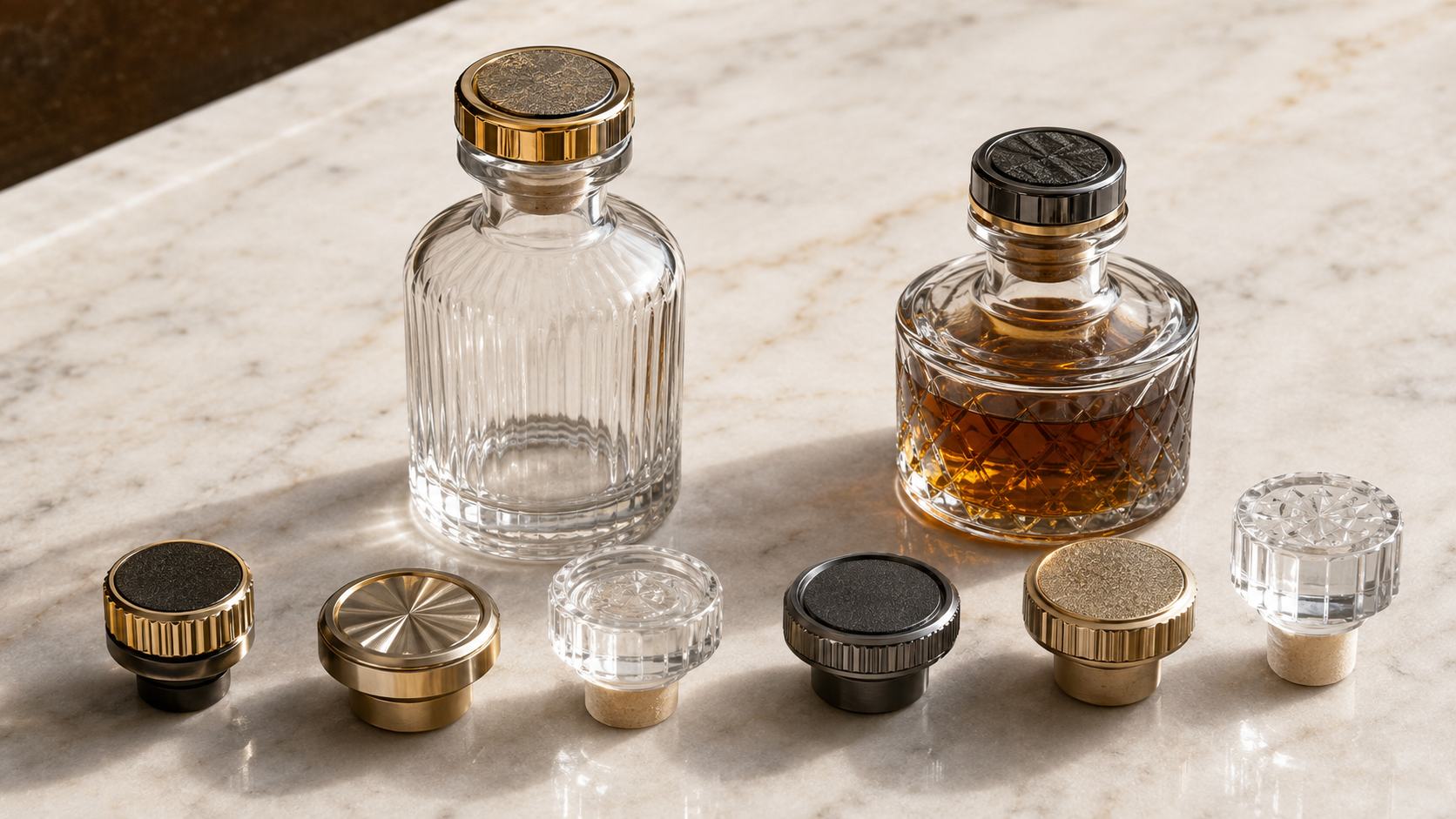
Not every product needs the same closure. A screw cap may be ideal for reclosable convenience, high-speed filling, miniature spirits, oils, RTDs, and many export-ready bottle formats. ROPP closures may be preferred for tamper evidence and efficient bottling. Bar-top stoppers may better suit premium spirits where opening ritual and shelf impact matter more than high-speed line compatibility.
For buyers comparing bottle closure options, Kandacork’s guide to bottle closures and stoppers can help clarify when to choose a screw cap, cork stopper, ROPP closure, capsule, or non-refillable system.
The best choice depends on product category, price positioning, bottle finish, filling method, storage conditions, export route, and consumer expectations. Leakage prevention should be evaluated together with opening experience, tamper evidence, branding, cost, and production efficiency.
Why Work with Kandacork Closures?
Kandacork Closures supports brands that need reliable screw caps, custom closures, and packaging components for bottled products. Instead of treating the cap as a simple commodity, Kandacork Closures helps buyers evaluate the closure as part of the full packaging system.
For brands developing spirits, liqueurs, beverages, oils, syrups, cosmetics, and specialty liquids, this support can reduce leakage risk before production begins. The team can help review cap style, liner options, bottle compatibility, decoration requirements, tamper-evident features, and sample approval steps.
This is especially valuable for brands ordering custom screw caps, decorated closures, premium metal caps, tamper-evident caps, or packaging for export. When the bottle and closure are aligned early, the project can move from sampling to bulk production with fewer surprises.
Kandacork Closures can also support buyers who need coordinated bottle closure systems across screw caps, ROPP caps, capsules, non-refillable closures, and stoppers.
Screw cap leakage prevention is not only a technical issue. It is also a brand protection issue. A clean, secure, leak-free bottle gives buyers, distributors, retailers, and consumers more confidence in the product.
FAQ
How do you prevent screw caps from leaking?
Prevent screw caps from leaking by matching the cap to the bottle neck finish, selecting the correct liner, applying the cap within the proper torque range, and testing filled samples under realistic storage and shipping conditions.
Can over-tightening a screw cap cause leakage?
Yes. Over-tightening can deform the liner, damage the threads, distort the bottle finish, or create uneven sealing pressure. A cap should be tightened to a tested torque range, not simply tightened as much as possible.
What is the best liner for screw cap leakage prevention?
The best liner depends on the product, bottle, cap, filling process, and storage environment. Foam, PE, EPE, pressure-sensitive, induction, and barrier liners each serve different purposes. For alcohol, oils, and aromatic liquids, compatibility testing is especially important.
Why does my bottle leak even when the cap is tight?
A tight-feeling cap may still leak if the liner is damaged, the cap is over-torqued, the bottle neck finish does not match, the sealing land is uneven, or product residue is trapped under the liner.
Should screw caps be tested before bulk orders?
Yes. Screw caps should be tested with the actual bottle, product, liner, torque setting, and shipping conditions before bulk production. Filled-sample testing is more reliable than checking empty components separately.
What is torque in screw cap packaging?
Torque is the rotational force used to apply or remove a cap. Application torque affects how the cap seals during production. Removal torque shows how the closure performs after storage and whether consumers can open it comfortably.
Why do bottles leak during shipping?
Bottles may leak during shipping because of vibration, impact, carton compression, temperature changes, pressure changes, poor torque retention, or an unsuitable liner. Products shipped internationally or through e-commerce channels should be tested under more demanding conditions.
Is an induction seal better than a foam liner?
An induction seal can provide stronger tamper evidence and leak resistance for many products, but it is not always necessary. A foam liner may be suitable when the product, bottle, cap, torque, and shipping conditions are properly validated.
What should buyers check before ordering screw caps in bulk?
Buyers should check the bottle neck finish, cap thread match, liner compatibility, torque range, tamper-band fit, filled-sample leakage results, and shipping conditions before approving a bulk screw cap order.
How can Kandacork Closures help prevent leakage?
Kandacork Closures can help buyers match screw caps, liners, bottle finishes, decoration options, and sample testing requirements before mass production. This reduces the risk of leakage, poor fit, tamper-band failure, and costly bulk-order issues.
Conclusion
Screw cap leakage prevention depends on more than choosing a cap that looks right. A leak-free package requires the correct match between bottle neck finish, screw cap thread, liner material, application torque, filling conditions, product chemistry, and transport testing.
For buyers, the safest approach is to validate the entire packaging system before bulk orders. Review drawings, test filled samples, measure torque, inspect liner compression, simulate storage and shipping, and approve a golden sample before mass production.
Kandacork Closures helps brands move through this process with greater confidence. For buyers managing complete packaging programs, the wider Kandacork group can also support integrated glass development through Kandacork Glass and multi-category packaging through Kandacork Glass Packaging.
By selecting the right closure system early, brands can protect product quality, reduce leakage complaints, and deliver a more professional experience from production line to final customer. For sample review, technical matching, or bulk-order planning, buyers can contact Kandacork Closures to discuss the bottle, product, cap, liner, and target filling conditions.